


Today I went deep on cross asset vol, equity long short positioning, carry trades, and CTA flows. Vol has collapsed across equities, rates, and FX simultaneously, which mechanically forces vol targeting and risk parity funds to lever up into the same names.
The proprietary macro research for paid subscribers is just below the summary and slide deck from today’s livestream. I also provided the code for the internal STIR model I run.
LIVESTREAM RECORDING FROM TODAY:
Today’s Livestream: Main Talking Points
1. Until you break a multi day consolidation range to the downside, this trend does not turn. Pulling back into a prior consolidation range and finding bids off trapped sellers is the same playbook we have seen for two months. There are no inventory longs trapped overhead. The range below is full of trapped sellers who become future buyers as they cover. That dynamic flips supply and demand in a single session, which is why every micro dip rips back to highs within 24 hours. - PharmD_KS
2. A liquidation break is the most bullish setup in a maturing trend, not the bearish one. When sellers force a 1.5 to 2 percent whoosh through prior consolidation ranges, longs puke and shorts cover. That clears the supply overhead and creates a vacuum. The next leg up has no resistance because the weak hands are gone. If you have been locked out of this rally, that liquidation break is the buyable opportunity.- PharmD_KS
3. Cross asset vol has collapsed across the VIX, MOVE, and CVIX simultaneously, and the correlation between them is rising. When equity vol, rate vol, and FX vol all collapse together, that is a macro factor signal, not an idiosyncratic one. It tells you capital is moving out the risk curve across every asset class at the same time. That is the regime that mechanically forces vol targeting funds and risk parity funds to lever up.
4. The inelastic market hypothesis is the amplifier nobody is mapping. One dollar of passive index flow lifts the market by five dollars because passive investors buy and never sell. The S&P top seven stocks now control a massive part of the index. Every dollar of passive flow gets concentrated into those seven names, which is why the equal weighted RSP is still below all time highs while SPY is at highs. When we eventually get a real selloff, that same mechanic works in reverse and makes the move violent. Michael W. Green has a lot of great work on this. If you are trying to conceptualize this idea, reference 1 hour and 2 mins in the livestream.
5. The IGV up SMH down divergence is the equity long short positioning unwind in real time. Hedge funds are positioned long SMH and short IGV. The unwind is not going to be a violent SMH crash. It will be an orderly bid in IGV that drags the index higher while SMH consolidates. Microsoft holding flat as the institutional anchor for OpenAI and Azure tells you the unwind has more room to run.
6. The carry trade complex is extreme across every asset class right now. Yen funded dollar long positions, peso longs, EUR/JPY, the entire G10 carry index sits at extremes. As long as cross asset vol stays compressed, the carry trade keeps paying. The risk is not that the carry trade fades. The risk is that vol blows out somewhere and forces a coordinated unwind across every leveraged position simultaneously.
7. CTA positioning is at all time highs, which works on the upside and works on the downside. The CTA index just hit a new high. Trend followers are max long S&P, max long gold, and at extremes on every major asset. That is the marginal flow pushing the melt up further. It also creates the asymmetric risk: when CTAs unwind, they unwind everything at the same time across every market.
8. Capital is moving out the risk curve. High quality versus low quality factor down 14 percent, stagflation factor down 14 percent, OpenAI ecosystem leading attribution. Liquidation Nation’s factor breakdown shows the market is paying capital to take risk and punishing capital that hides in defensive trades. The OpenAI ecosystem is the single largest factor driving returns over the past month. That is the signature of a credit cycle melt-up funneling into a specific set of beneficiaries.
Slide Deck and Playbooks:
Here is the slide deck from today’s livestream:

Tomorrow's Livestream: Full Economic Picture: Connecting Growth and Inflation to Long-Term Interest Rates
Tomorrow, I lay out the full economic picture and connect every major growth and inflation data point to long-term interest rates. Long-end rates price long-term nominal GDP, which means they reflect the market’s view on growth plus inflation over the cycle. I walk through the labor market, capex, productivity, ISMs, services data, headline and core inflation, trimmed mean, and inflation expectations to map exactly where the long end should sit and where it actually is. The gap between those two is the trade. Plus what NFP on Friday means for the framework heading into next week.
TOMORROW’S LIVESTREAM: LINK
Paid Subscriber Section: Proprietary Macro Research
I told everyone today that I would be sharing part of the proprietary dashboard I run to monitor and map interest rates (link). You can find the code and instructions to run it below.
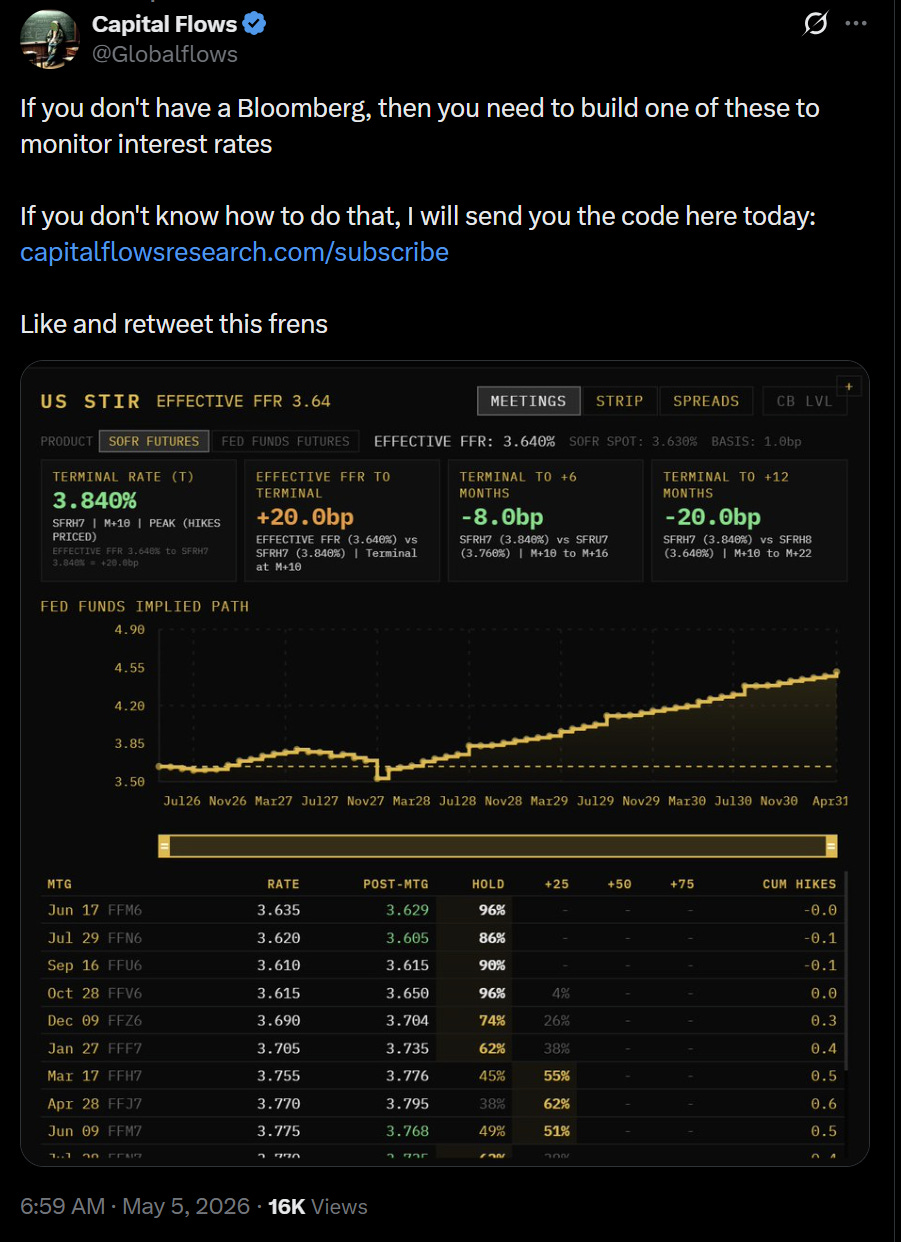
Once you pull the data, you can feed this PDF into your AI or manually go through and copy/paste the code yourself: