


Today I went through the full FOMC setup heading into Powell’s last meeting that matters before the Warsh handoff. Jaymes Rosenthal and I walked through the policy error transmission framework, the 2018 case study where the curve flattened and equities sold off twenty percent on hawkish error, and how the Powell-to-Warsh framework handoff is going to fundamentally diverge interest rate policy from balance sheet policy. The market is pricing a hundred percent probability of a hold tomorrow. Inflation swaps are rising. Real rates are falling. The Fed’s inaction into rising inflation expectations is the mechanical liquidity impulse that has fueled the melt-up, and that setup is intact heading into the meeting.
LIVESTREAM RECORDING FROM TODAY:
Today’s Livestream: Main Talking Points
1. Powell vs Warsh have fundamentally different views on what inflation actually is. That gap is the framework handoff. Powell believes inflation is something that happens to the Fed and the Fed responds to it. Warsh believes inflation is the Fed’s choice. That single difference defines the entire regime transition. Under Powell, every framework is reactive: cut into weakness, hike into inflation, expand the balance sheet in concert with cuts, contract in concert with hikes. Under Warsh, the framework becomes proactive and tools get split: cut rates while contracting the balance sheet, target trimmed mean rather than headline, anchor expectations through changed communication rather than dot plots. The Powell-to-Warsh handoff is not personnel. It is framework.
2. The forward curve is pricing 100 percent probability of a hold tomorrow and a pause across the year. Z6 SOFR is in the middle of its range. The market is no longer pricing cuts or hikes for the rest of this year. Z6 is sitting at the midpoint of its oscillation band. That tells you the market has fully digested the Fed’s wait-and-see posture and is now waiting for the Warsh transition to provide direction. Tomorrow’s meeting matters less for what it does and more for what it does not say. Anything Powell signals about the framework becomes the baseline Warsh either inherits or breaks.
3. Inflation swaps are rising and the Fed is pausing into that. The mechanical result is real rates falling, and that is the liquidity engine. Over the last week, one-year and two-year inflation swaps have moved up. The Fed has not moved. Real rates falling is what mechanically pushes capital out the risk curve. This is exactly the framework Warsh has been describing. The Fed does not need to cut to be stimulative. The Fed just needs to not respond to rising inflation expectations, and the gap between nominals and inflation expectations widens, and real rates compress. We are in that regime right now and the data confirms it.
4. The long end always prices the Fed’s policy error. That is the lens for reading the curve into FOMC. When the Fed makes a dovish error like 2021, the curve bear steepens because long end rates rise to price the error. When the Fed makes a hawkish error like 2018, the curve flattens and equities sell off as growth gets crushed. When the Fed pauses into a shifting regime, you get steepener twists. Right now the curve is showing modest steepening with the long end pricing in some inflation pass-through risk, but nothing that signals a major error yet. The currency and the thirty year yield are the cleanest expressions of the Fed’s net policy error, and both are still in the structural bid for risk regime.
5. The 2018 case study is the cleanest map of what a hawkish error does to equities. Inflation swaps falling plus the Fed hiking equals a 25 percent drawdown. In Q4 2018, two-year inflation swaps were falling. The Fed hiked into that. Real rates rose because nominals rose into falling inflation expectations. Equities sold off twenty five percent. That is the playbook for the bear case. The current setup is the opposite: inflation swaps are rising, the Fed is not hiking, real rates are falling, and equities are bid. Until inflation swaps roll over and the Fed gets aggressive into that, the 2018 analogue does not apply.
6. Warsh is going to diverge interest rate policy from balance sheet policy. That is a regime change most positioning has never seen. The historical pattern: cuts plus balance sheet expansion together, hikes plus contraction together. Warsh wants to break that. Cut rates to transmit to the real economy through the interest rate channel while contracting the balance sheet to offset asset price inflation. That has never been the Fed’s framework. Mapping liquidity in this new regime requires tracking quantity of money separately from the price of money, because they will move in opposite directions for the first time in the modern Fed era.
7. Bill issuance versus bond issuance is one of the most underpriced liquidity inputs in the market right now. When the Treasury issues bills, that is functionally injecting short-term money into the system. When the Treasury issues bonds, it pulls liquidity out in exchange for duration. The 2020-2021 bill-heavy issuance was a massive net liquidity impulse that nobody talks about. The 2023 Yellen pivot toward more bills and fewer bonds caused the equity bottom that fall. Warsh and Bessent will coordinate the duration mix going forward, and shifting the balance can move equity markets significantly without any rate change at all. This is the lever Trump’s team can pull without needing the Fed to act.
8. IGV vs SMH positioning divergence is still intact. Tech down 240bps on the day, IGV down 67bps. The hardware-vs-software split inside the tech complex tells you exactly where equity long-short positioning sits. With IGV holding levels while SMH gets sold harder, the long-short funds are positioned long IGV, short SMH. If FOMC produces any kind of vol event that forces unwinds, the rotation pushes IGV higher and SMH lower in a way that is mechanical, not fundamental. The setup remains the same as I have been mapping for the past two weeks. The catalyst is FOMC tomorrow plus the PCE print on Friday.
Slide Deck and Playbooks

All educational primers on credit risk, duration risk, the yield curve regime model, and the equity risk curve are free on the Substack.
![[FREE] Educational Primers On Every Aspect Of Macro & Markets](https://substackcdn.com/image/fetch/$s_!tfas!,w_140,h_140,c_fill,f_webp,q_auto:good,fl_progressive:steep,g_auto/https%3A%2F%2Fsubstack-post-media.s3.amazonaws.com%2Fpublic%2Fimages%2F69c49472-3d63-47f0-9b8c-2a682fa625f1_1024x1024.jpeg)
Tomorrow's Livestream: Reading the FOMC: How the Curve Reprices Powell's Last Stand
Tomorrow, I will be breaking down all of the levels, tensions, and interest rate signals to understand moving into the actual FOMC meeting.
TOMORROW’S LIVESTREAM: LINK
Paid Subscribers Report On Interest Rate Positioning and Volatility:
In the livestream today, I talk about how important it is to understand interest rates. Fundamentally, interest rates are the asymmetrical linchpin on which the entire economy turns.
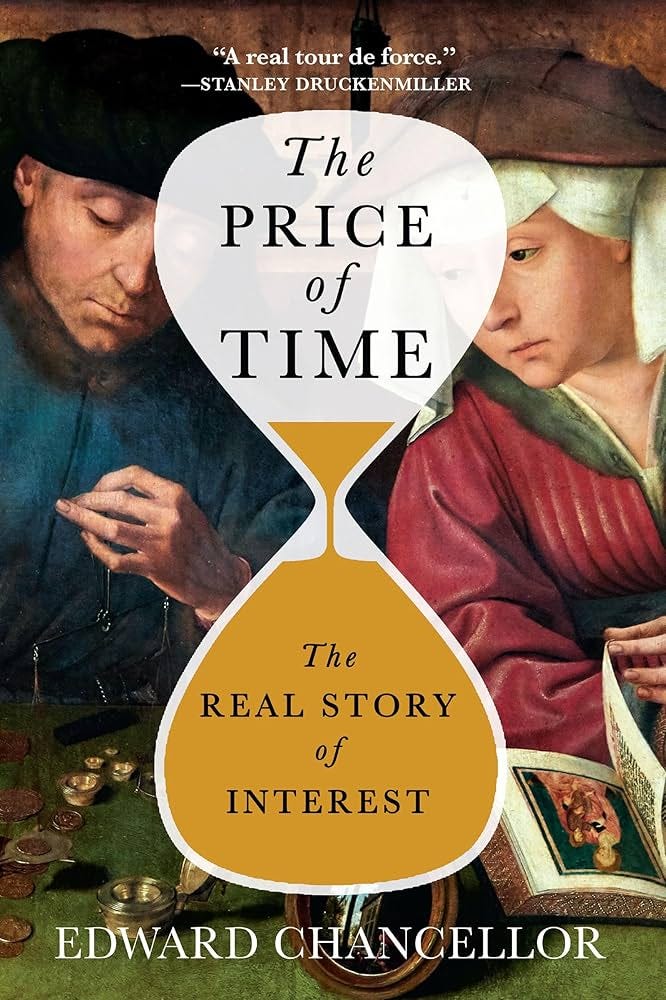
Interest rates cause the rise and fall of nations because they are the direct input into the currency. All goods, services, and assets are denominated in the currency. Interest rates impact EVERYTHING. This is the book I recommend to everyone on understanding the significance of rates.
How does all of this connect to WHERE we are right now, though?