


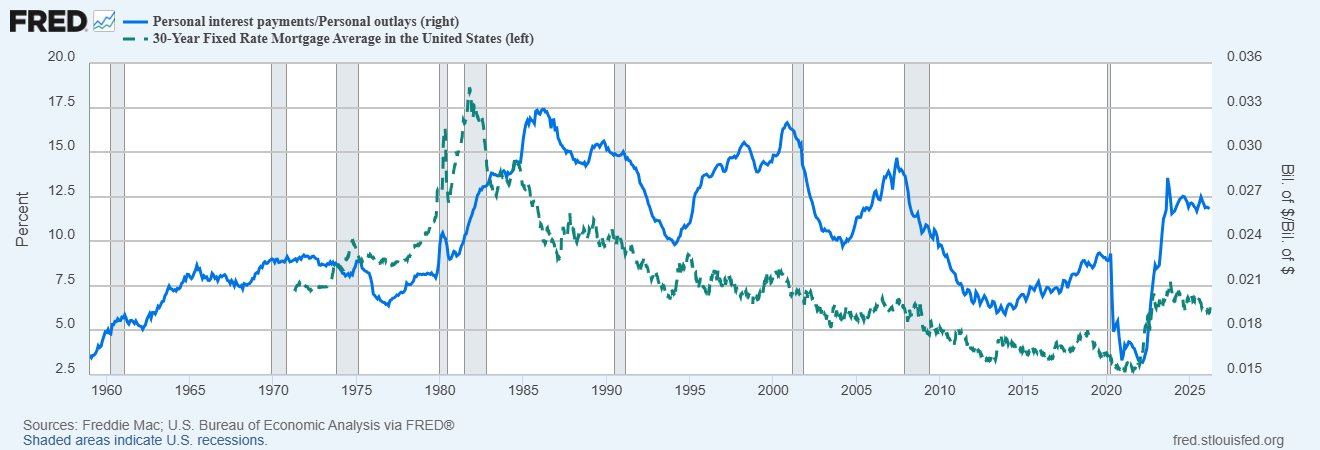
Today, I broke down every major growth and inflation data point and connected it to long term interest rates and asset prices. Real GDP is running at 2 percent, nominal at 6, and the Atlanta Fed Nowcast is at 3.7 with fixed investment adding 100bps. Personal interest payments are at highs but delinquencies are not rising, which tells you the consumer is more resilient than the bears want to admit. The full slide deck and the STIR replication playbook with all the code are available for paid subscribers.
LIVESTREAM RECORDING FROM TODAY:
Today’s Livestream: Main Talking Points
1. Real GDP at 2 percent and nominal at 6 percent is a strong macro regime, period. Even if you assume the data is lagged, getting from 2 percent to recession requires a sustained deceleration that takes time. The Atlanta Fed Nowcast is at 3.7 percent. Fixed investment alone is adding almost 100bps. None of that is consistent with the recession narrative that has been getting cooked for two years.
2. Consumption is 68 percent of GDP and the personal income and outlays data set is the monthly proxy for it. When the data prints monthly and matches GDP almost exactly, you can nowcast quarterly GDP in real time. Every major hedge fund uses credit card data on top of that to refine the estimate. The idea that there is a “hidden recession” not showing up in the data is a tell that someone has not built their own models.
3. We are in reflation, not stagflation. Growth and inflation are both positive, which is the regime where equities rally. Stagflation requires growth decelerating into rising inflation. We do not have that. Real spending is positive, discretionary spending is resilient, and inflation is contained outside of energy. Equities do not rally during stagflation. Equities are rallying.
4. Personal interest payments as a percentage of outlays are at highs, but delinquencies are not rising. That is the cleanest consumer resilience signal in the data. If consumers were getting crushed by debt service, discretionary spending would fall first before delinquencies spiked. We are seeing neither. The mortgage market is more resilient than people want to admit because the 30 year fixed structure locked in low payments for the majority of homeowners.
5. Government spending at 17 percent of GDP plus a 5 percent fiscal deficit plus a negative trade balance is exactly why long end rates are stuck in range. Long end rates price the term premium, which is driven by issuance composition and inflation expectations. As long as the deficit stays elevated and the trade balance stays negative, long end rates have a structural floor. They are not breaking down to 2 percent without a fundamental shift in the fiscal picture.
6. The Fed letting short term real rates run lower than they should is what is creating the dollar weakness. Short term real rates lower than the structural level forces capital out of the dollar and into risk assets. This is why the dollar is bearish, EUR is bid, MXN is making new highs, and the carry trade is at extremes across G10. EWW remains the cleanest equity expression of the Mexico flow.
7. Headline CPI matters more in Europe and Japan because they are net importers of crude. Core matters more in the US because we are a net energy exporter. This is why the dollar rallied during the recent geopolitical shock. Higher crude transmits faster into European inflation than US inflation, which moves rate differentials in favor of the dollar. As crude fades, that flow reverses and the dollar resumes the structural decline.
8. The Fed allowing inflation to seep into the system without hiking is the liquidity impulse that keeps capital moving out the risk curve. Inflation rising plus the Fed pausing equals real rates falling, which mechanically forces capital into equities. SMH melting up today is the AI capex transmission. The Russell holding range is the small cap capex transfer recipient. The credit cycle melt up extends as long as this regime stays in place.
Slide Deck and Playbooks

All of the models:
Models: (These TradingView models are the ones that I use every day. If you are trying to understand how to use them, just plug them into AI and ask for an explanation.)
https://www.tradingview.com/chart/kZ8JijHH/ (Models from my friend Alfie https://substack.com/@alfiekerswell)
If you don’t have a Bloomberg, the CME Tools are your best friend:
![[FREE] Educational Primers On Every Aspect Of Macro & Markets](https://substackcdn.com/image/fetch/$s_!tfas!,w_140,h_140,c_fill,f_webp,q_auto:good,fl_progressive:steep,g_auto/https%3A%2F%2Fsubstack-post-media.s3.amazonaws.com%2Fpublic%2Fimages%2F69c49472-3d63-47f0-9b8c-2a682fa625f1_1024x1024.jpeg)
Livestream Tomorrow:
I’m traveling tomorrow morning and won’t be able to do the livestream at the regular time, but I will be doing a livestream later in the day. I am just unsure about the time right now. I will send out an email when I know and when the livestream starts.
Thanks
The information on this website/Substack is for information purposes only. It is believed to be reliable, but Capital Flows does not warrant its completeness or accuracy. The information on the website/Substack is not intended as an offer or solicitation for the purchase of stock or any financial instrument. The information and materials contained in these pages and the terms, conditions and descriptions that appear, are subject to change without notice. Unauthorized use of Capital Flows websites and systems including but not limited to data scraping, unauthorized entry into Capital Flows systems, misuse of passwords, or misuse of any information posted on a site is strictly prohibited. Your eligibility for particular services is subject to final determination by Capital Flows and/or its affiliates. Investment services are not bank deposits or insured by the FDIC or other entity and are subject to investment risks, including possible loss of principal amount invested. Your use of any information which is proprietary to Capital Flows or a third-party information provider shall only be used on individual devices without any right to redistribute, upload, export, copy, or otherwise transfer the information to any centralized interdepartmental or shared device, directory, database or other repository nor to otherwise make it available to any other entity/person/third party, without the prior written consent of Capital Flows.
I really like how you laid out your written breakdown of the Livestream. Sometimes I can't listen to a whole livestream so this was helpful.
Such an excellent article! Thank you for sharing this.