


Intro To Country Primers:
I laid out the framework for WHY I am writing a series of country primers in the Japan Primer. There has already been a ton of positive feedback so we won’t slow down. Developing this TYPE of knowledge about a country is comparable to building a factory. Once you set the foundations for operations, you simply need to run the factory to make money. Knowledge of countries throughout the world functions in the exact same way.
Country Primers: Japan

Intro To Country Primers: Global macro trading is made up of generalists who morph across all countries in the world to find asymmetrical returns. To identify asymmetrical returns, you need an exceptional knowledge of every country, sector, and asset in the world.
All of the educational articles on global macro are here:
Research Synthesis / Direction Of Capital Flows Substack

Hello everyone, There has never been a time in history when understanding the world from a global perspective and interpreting it accurately paid such a high premium. Since the very beginning of this Substack, I have talked about the nature of the time we live in and how to act intentionally in it.
And all the details about where we are going with the Substack are in the “About” section.
Today, we are going to cover a country that presents one of the most significant investment opportunities for the next decade. The country as a whole has a lot of upside but there are specific asymmetrical points in the economy that are essential to know from a global perspective.
Remember how everyone was talking about deglobalization and supply chain issues last year? While that was happening, the Mexican stock market was outperforming the S&P500. This year, the Mexican stock market has made ATH while the S&P500 remains below ATHs.

On top of that, the Peso has been one of the best-performing currencies against the dollar over the past 2 years, even amidst the FED’s tightening cycle:

Main idea: Significant asymmetrical opportunities exist in Mexican financial markets over the next year and the coming decade. The goal of this primer is to set an exceptional foundation of knowledge for identifying these opportunities.
Overview: Here is the structure for this primer
Country Overview
Geography and Demographics
Economic Data: GDP, GNI, BoP, and Balance Sheets
Financial Markets: Stocks, Bonds, and the Peso.
History of growth, inflation, and liquidity on a structural and cyclical basis
Current growth, inflation, and liquidity regime and its connection to each financial asset
Additional resources for research and trading in Mexican markets
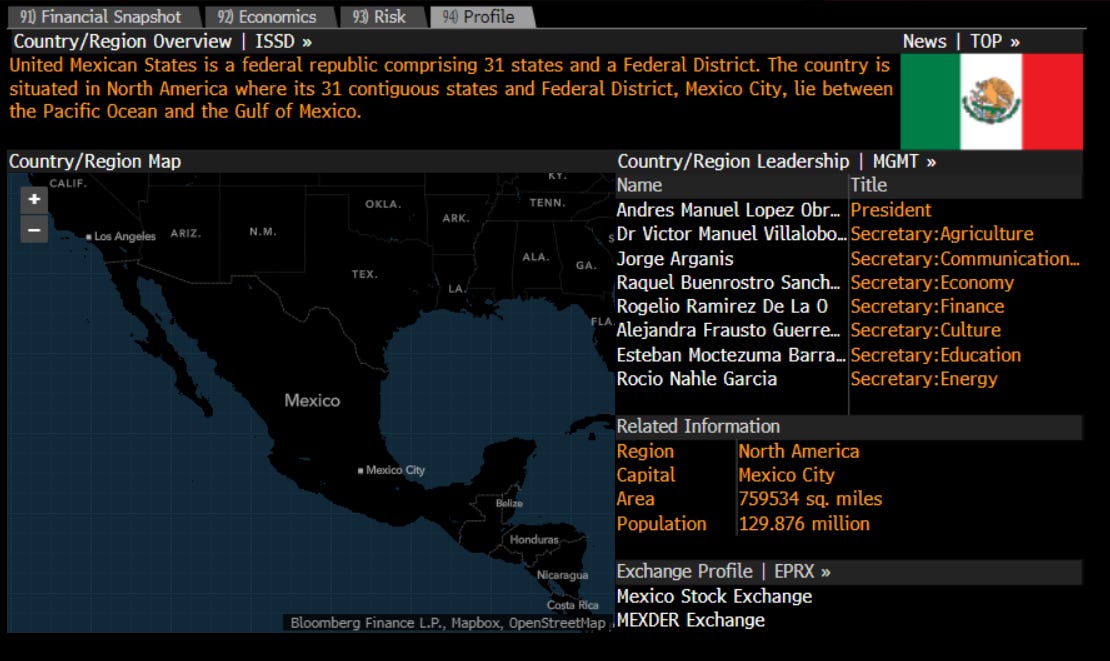
Country Overview:
The site of several advanced Amerindian civilizations - including the Olmec, Toltec, Teotihuacan, Zapotec, Maya, and Aztec - Mexico was conquered and colonized by Spain in the early 16th century. Administered as the Viceroyalty of New Spain for three centuries, it achieved independence early in the 19th century. Elections held in 2000 marked the first time since the 1910 Mexican Revolution that an opposition candidate - Vicente FOX of the National Action Party (PAN) - defeated the party in government, the Institutional Revolutionary Party (PRI). He was succeeded in 2006 by another PAN candidate Felipe CALDERON, but Enrique PEÑA NIETO regained the presidency for the PRI in 2012. Left-leaning anti-establishment politician and former mayor of Mexico City (2000-05) Andrés Manuel LÓPEZ OBRADOR, from the National Regeneration Movement (MORENA), became president in December 2018.
Mexico is currently the second-largest (after Canada) goods trading partner of the US with nearly $780 billion in two-way goods trade in 2022. Mexico's GDP contracted by 8.2% in 2020 due to pandemic-induced closures, its lowest level since the Great Depression. Mexico’s economy is rebounding; it grew by 4.8% in 2021, driven largely by increased remittances, despite supply chain and pandemic-related challenges, and grew by 3% in 2022.
The US-Mexico-Canada Agreement (USMCA, or T-MEC by its Spanish acronym) entered into force on 1 July 2020 and replaced its predecessor, the North American Free Trade Agreement (NAFTA). Mexico amended its constitution on 1 May 2019 to facilitate the implementation of the labor components of USMCA.
Ongoing economic and social concerns include low real wages, high underemployment, inequitable income distribution, and few advancement opportunities, particularly for the largely indigenous population in the impoverished southern states. Since 2007, Mexico's powerful transnational criminal organizations have engaged in a struggle to control criminal markets, resulting in tens of thousands of drug-related homicides and forced disappearances.1
Geography and Demographics:
From a geopolitical perspective, Mexico is in one of the most advantageous positions in terms of its demographics and how shifts in global trade are impacting it. While many countries have been crushed by the deglobalization and supply chain issues, Mexico is benefiting exponentially.
A huge positive for Mexico is simply that it is in North America and has proximity to the United States. Contrary to popular narratives, the United States is unlikely to collapse over the next decade. It is actually likely to strengthen its position.
That doesn’t mean things aren’t changing though. The US is decreasing its presence in the world and the way it patrols global trade routes:
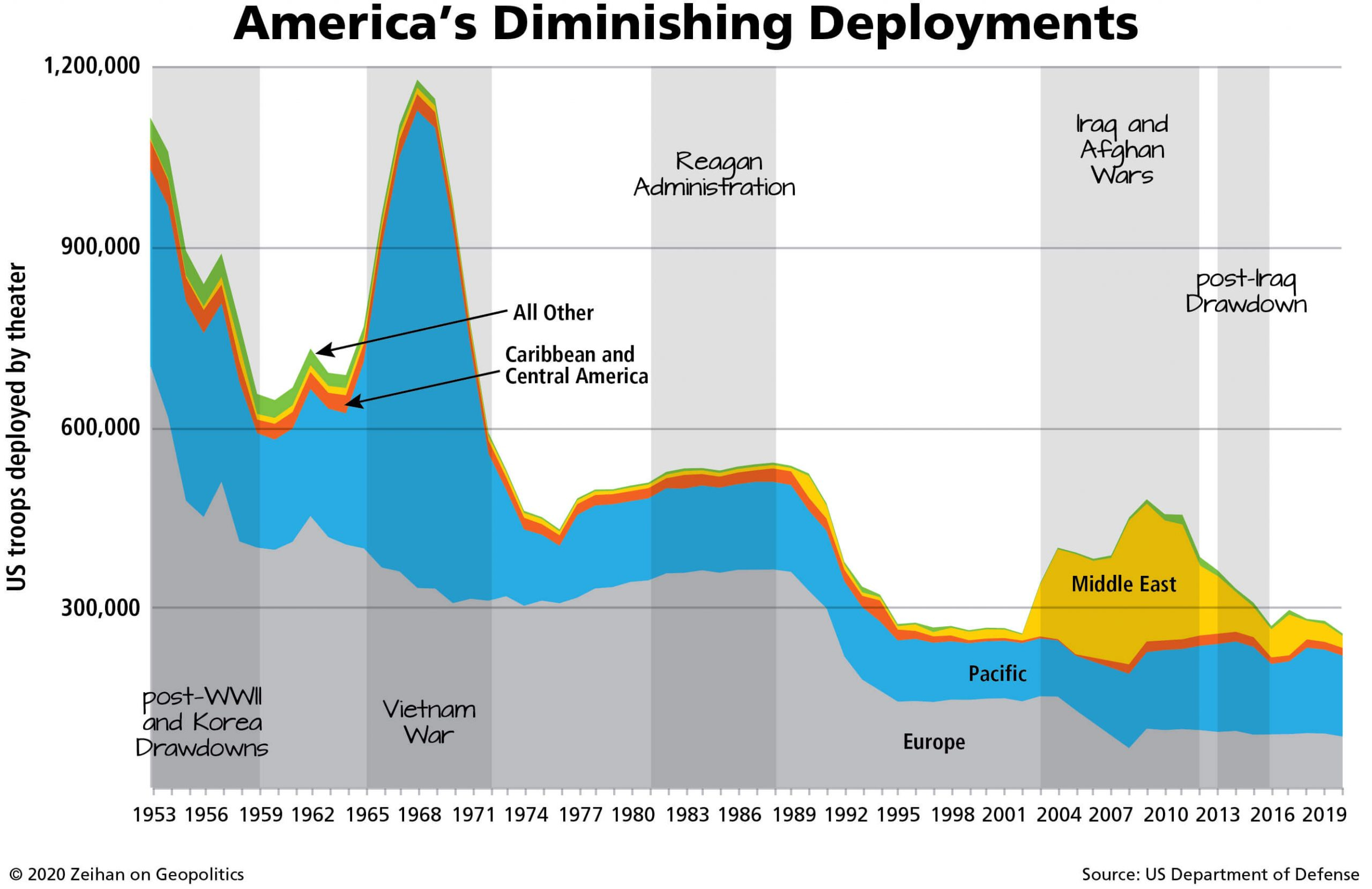
When you have a world of increasing multipolarity where the US isn’t getting involved in other people’s business as much, you need your manufacturing base in a reliable location.
It has been clear from a political and practical standpoint that China is no longer able to serve this function for the United States. This is not only because of the geopolitical risk but also because the Chinese economy continues to deteriorate.
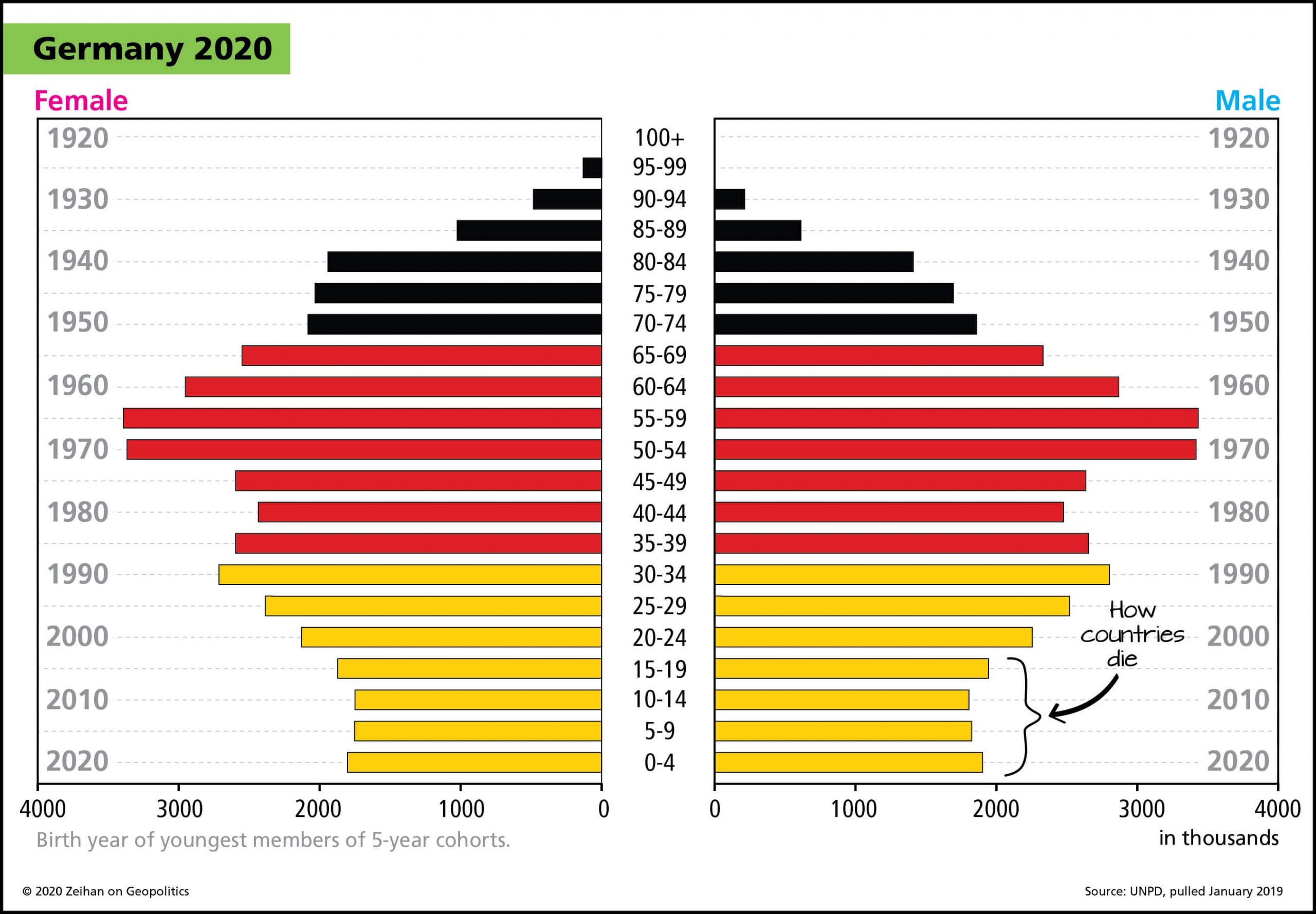
The question is, where does this industrial base shift to? It’s not going to be Germany because their demographic structure is weakening every year:
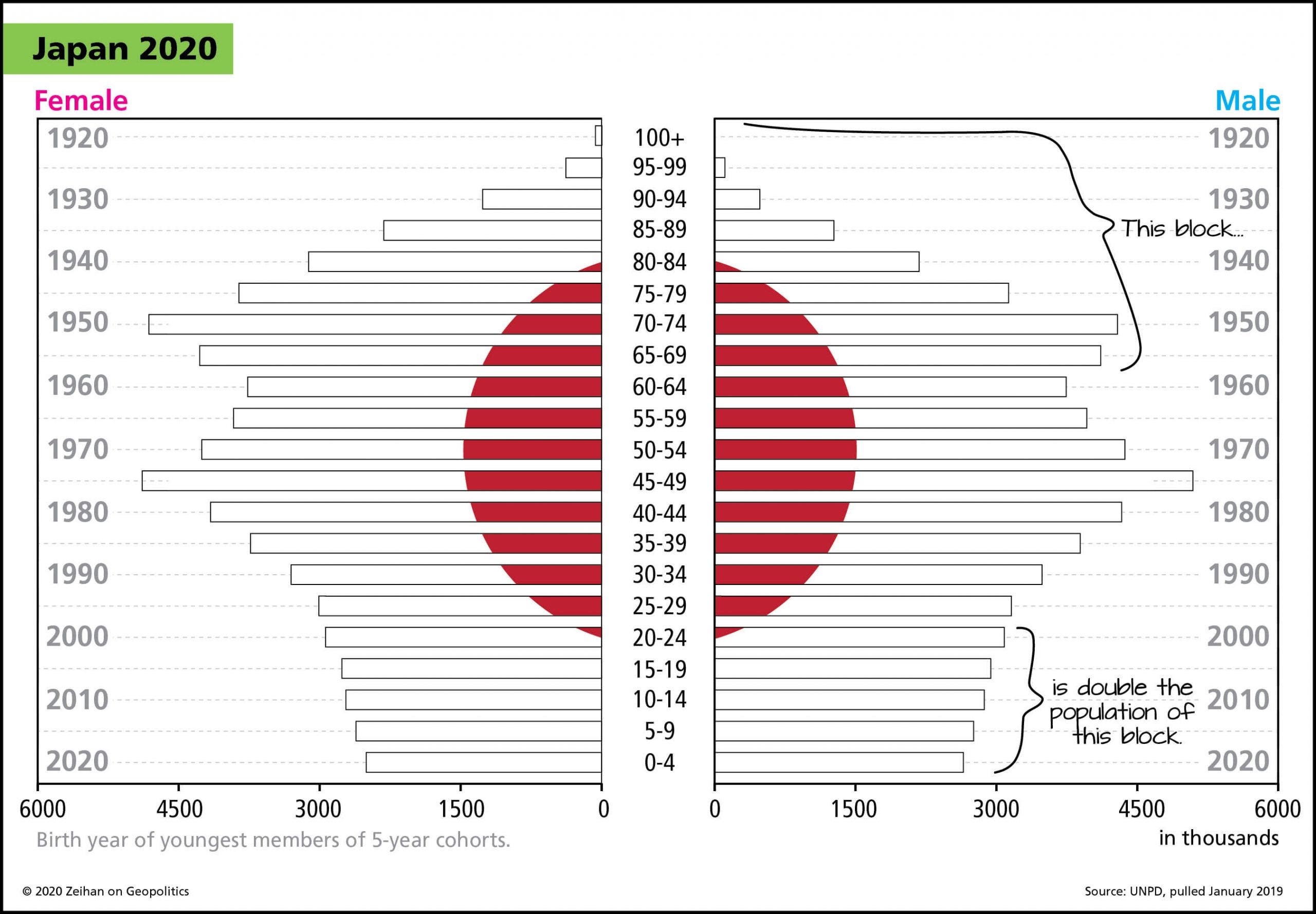
Japan can’t handle it because they have mostly retirees and are trying to offshore as much as possible (See Japan Primer on this: link):
And South Korea has the same problem:
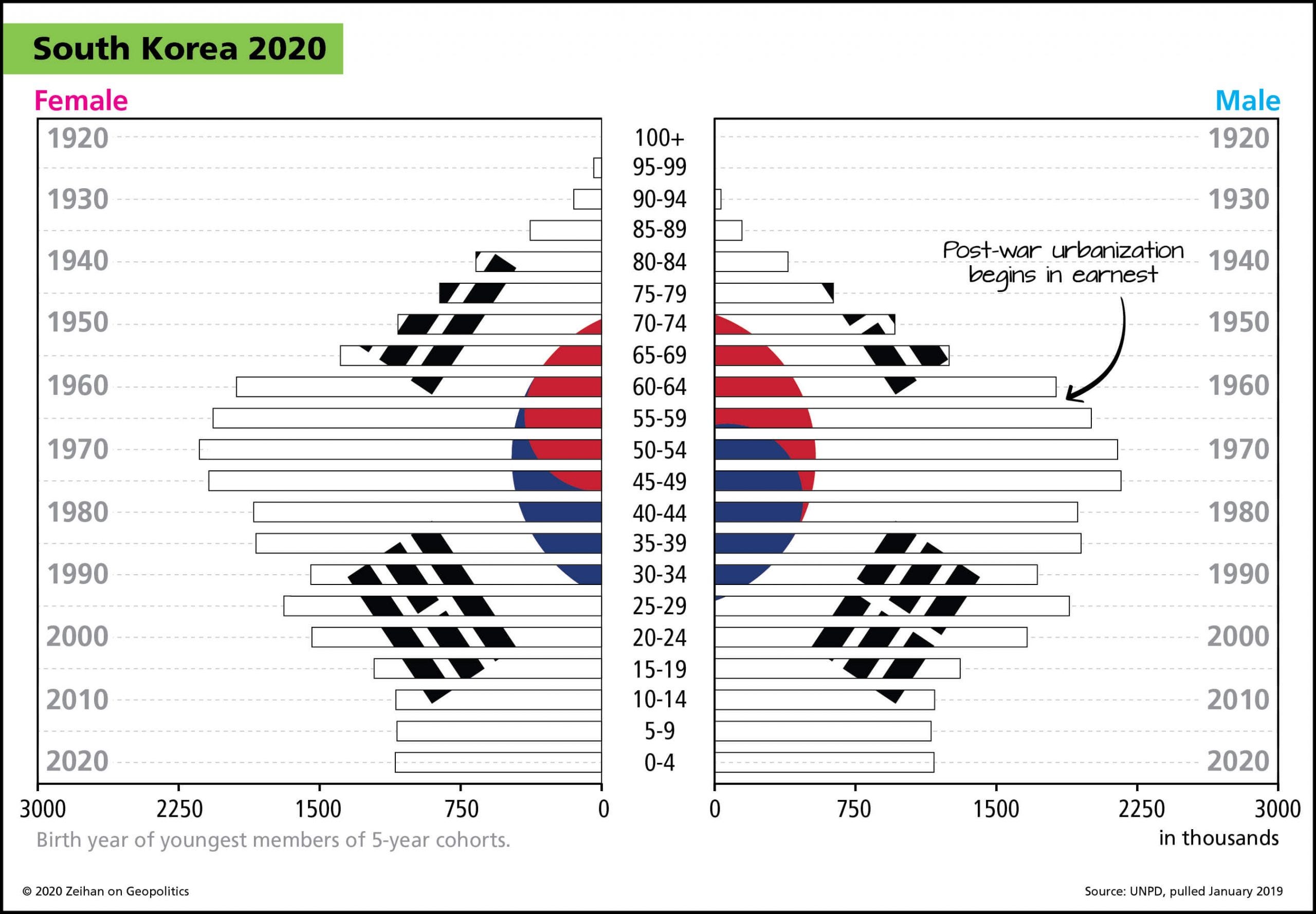
This is where Mexico enters the picture! You can notice their demographic structure is dramatically different. This is due to several reasons but the main one is that they industrialized after the countries above.
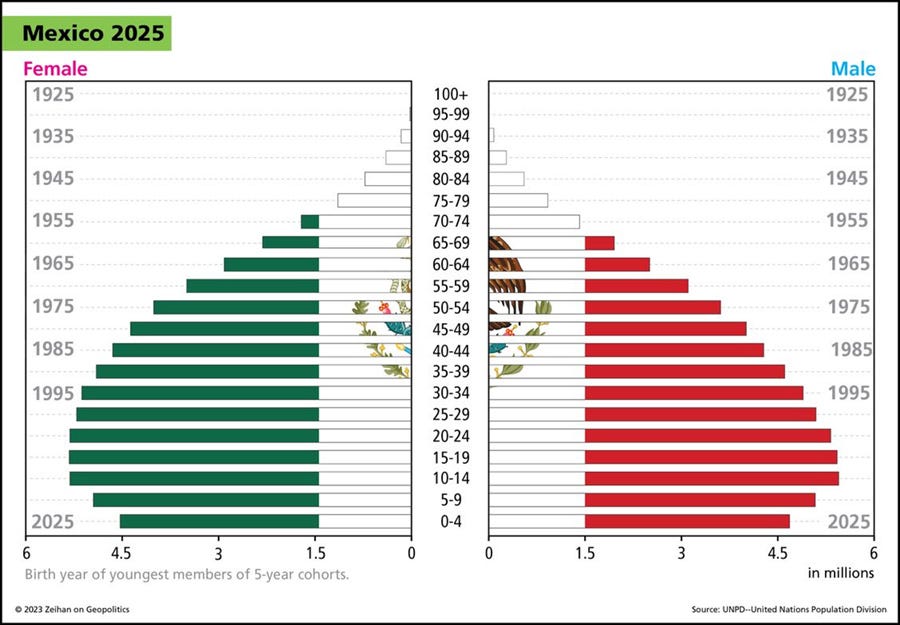
Just think about it like this, when a country industrialized, it usually urbanizes. When moving from farms to urban areas, children go from being assets to HUGE expenses. This doesn’t even account for the rocketing education costs and other cost of living issues we are seeing today.
Mexico is in an amazing situation where it has the demographics, it has the proximity to the United States and it has the trade agreement. Think about a trade agreement like having a massive client coming to your production factory and signing a contract for all the stuff they are going to buy from you over the coming years. Could the contract change? Maybe. But your bigger problem is having enough production capacity to meet the demand of this new contract.
Technical Breakdown of Trade:
The United States-Mexico-Canada Agreement (USMCA), which replaced NAFTA, includes several key provisions that have significant implications for the economies and investment landscapes of the United States and Mexico. Here are some of the main points of the agreement and their implications:
Automotive Sector Changes: A notable change is the increase in the percentage of a vehicle that must be manufactured in North America to qualify for zero tariffs, rising from 62.5% under NAFTA to 75% under USMCA. Additionally, it requires that 40-45% of auto content be made by workers earning at least $16 per hour.
Labor and Environmental Standards: The USMCA includes stronger labor and environmental standards, with mechanisms for enforcement. This includes commitments to adhere to International Labor Organization (ILO) standards and address issues such as forced labor and workplace discrimination.
Digital Trade: The agreement includes new provisions for digital trade, prohibiting customs duties on electronic transmissions and ensuring data can be transferred cross-border, while also protecting personal data.
Intellectual Property Protections: Enhanced protections for intellectual property rights, including patents and trademarks, are established, aiming to boost innovation and creative industries.
Agriculture and Dairy Access: USMCA maintains the tariff-free access for most agricultural goods in North American markets and increases U.S. dairy farmers' access to the Canadian market.
Dispute Settlement Mechanisms: The USMCA revamps the dispute settlement process, aiming for more transparency and efficiency, particularly in resolving trade disputes between member countries.
Sunset Clause: The agreement includes a 16-year lifespan with a review every six years, at which point the countries can choose to extend the pact.
Tangible Expression:
Now you might think, this sounds nice but when are we going to see the tangible impact of all this stuff? This chart says it all! Below is the gross fixed capital formation line items of Mexico's GDP. This is the functional equivalent of the investment line item of US GDP.
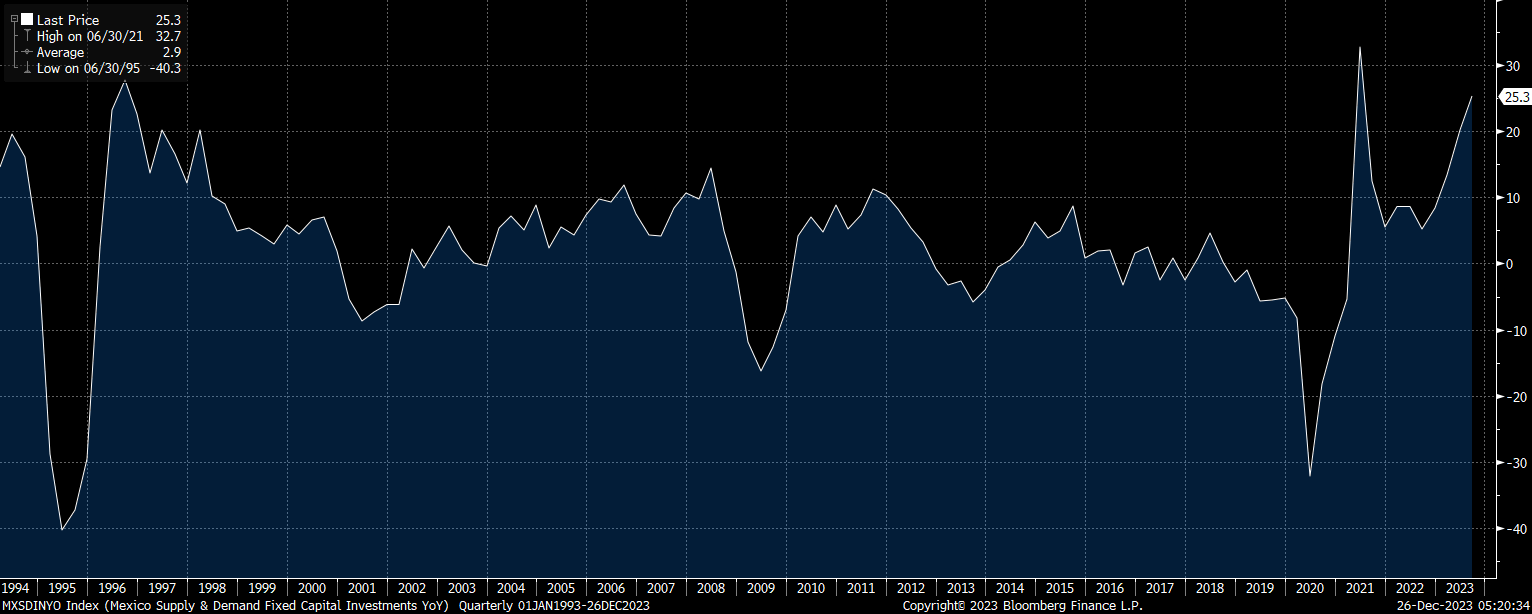
It is rare to see 25% YoY gross fixed capital formation when it’s not purely base effects. Here are the QoQ numbers just so there is no question:
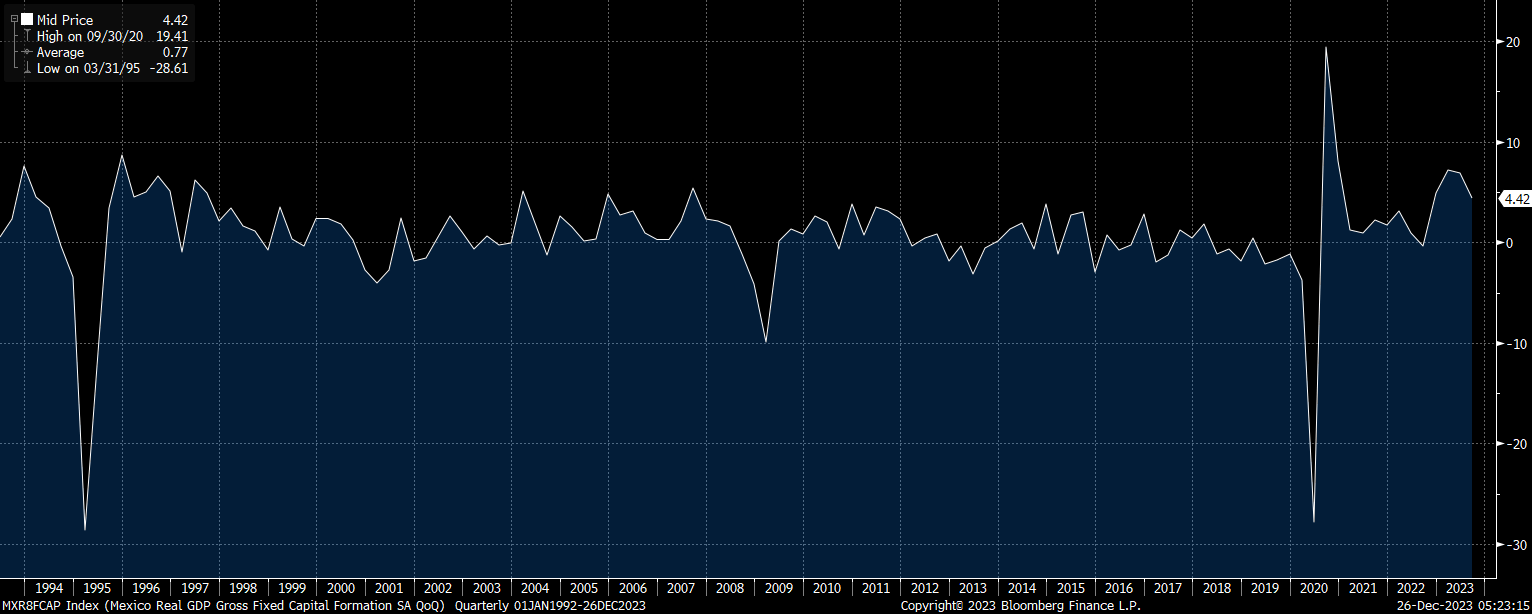
Oh and the biggest thing about this data is that it’s REAL GROSS FIXED CAPITAL FORMATION. These aren’t nominal numbers distorted by inflation.
Does it begin to make sense why the divergence between Mexico’s stock market (white) and China’s stock market (blue) is growing? I already noted above that Mexico has passed China in terms of trade volume with the United States. This is part of the tangible impact.
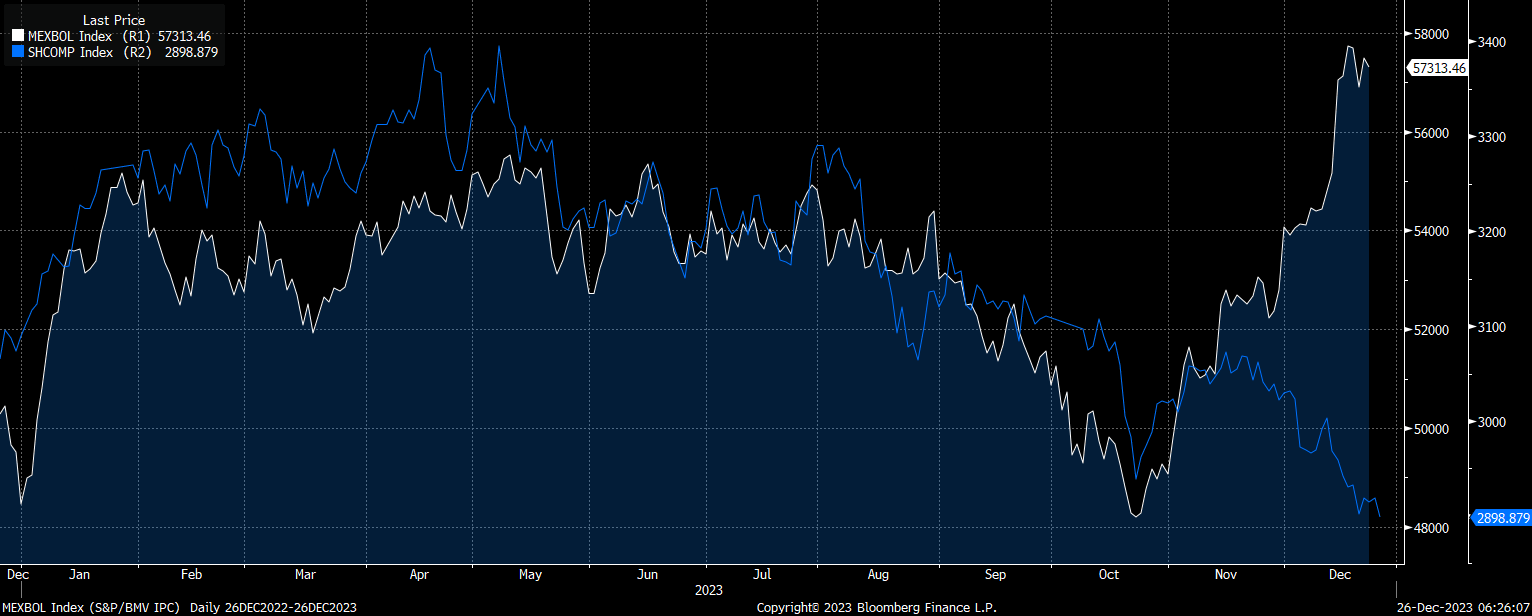
Here is the best thing about this shift, this is only the beginning. On a structural basis, this will continue to happen for the next 5-10 years. You can begin to see why I am writing a primer on Mexico.
Additional Details:
There are several additional details we need to cover in terms of geography and demographics:
Mexico’s Natural Resources: petroleum, silver, antimony, copper, gold, lead, zinc, natural gas, timber. 2
Land use:
agricultural land: 54.9% (2018 est.)
arable land: 11.8% (2018 est.)
permanent crops: 1.4% (2018 est.)
permanent pasture: 41.7% (2018 est.)
forest: 33.3% (2018 est.)
other: 11.8% (2018 est.)
Most of the population is found in the middle of the country between the states of Jalisco and Veracruz; approximately a quarter of the population lives in and around Mexico City.
In summary, Mexico has a robust foundation to be a positive beneficiary of the deglobalization trend. Monitoring any changes to trade agreements across all major countries will be key for estimating future growth in Mexico’s manufacturing base. Bottom line, Mexico is in the very early innings of a long-term growth trend.
Economic Data: GDP, GNI, BoP, and Balance Sheets
Now that we have the big-picture context for Mexico, we need to quantify each moving part of the economy with data. When we approach economic data, we want to quantify the FLOW and CAPITAL STRUCTURE for each agent (households, corporates, sovereigns, financial institutions). If you want a good book on this, check out The Volatility Machine.
Let’s start big picture:
Here is a chart of Nominal (white) and real GDP (blue) on a YoY basis:
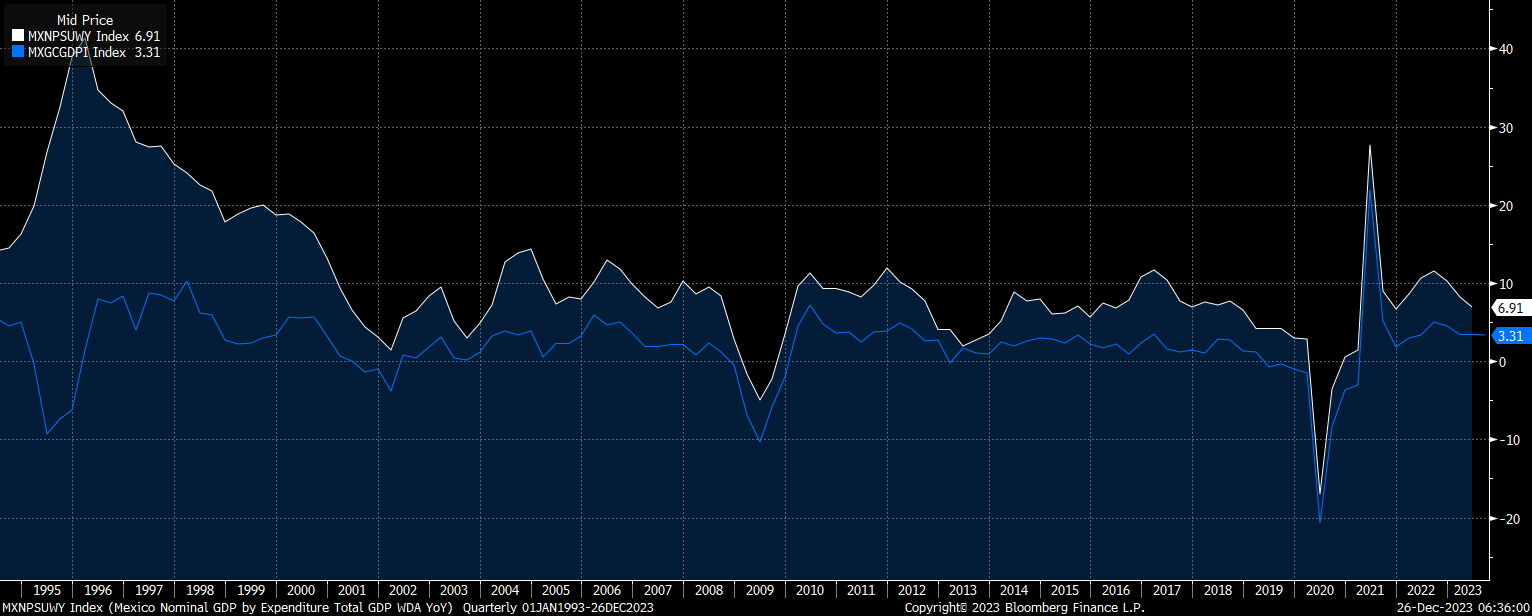
Real GDP:
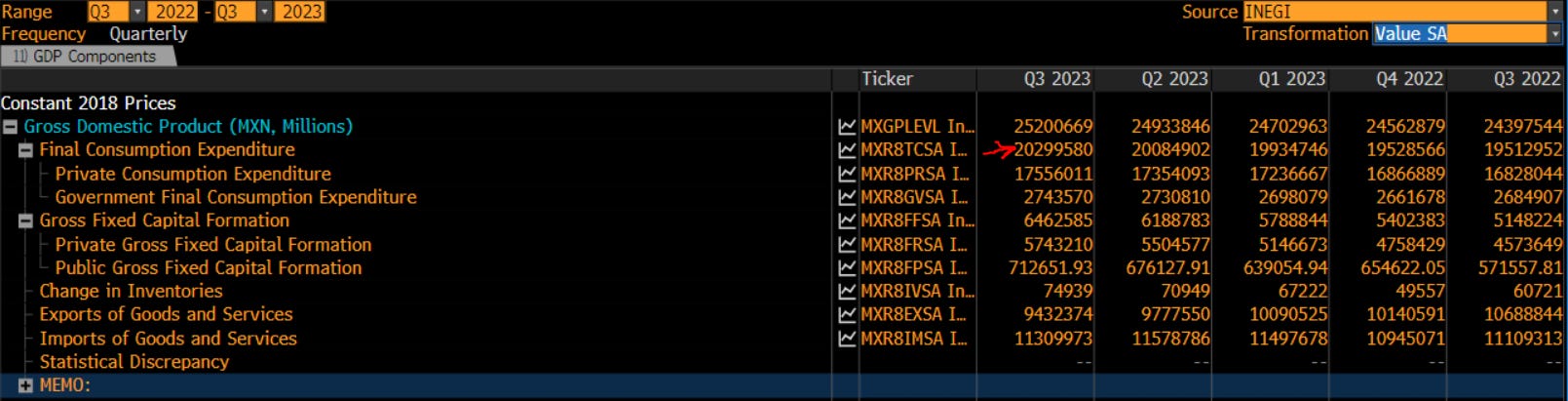
GDP is broken down into private consumption, government consumption, private gross fixed capital formation, public gross fixed capital formation, inventories, and imports/exports.
Private consumption is the largest line item for GDP:
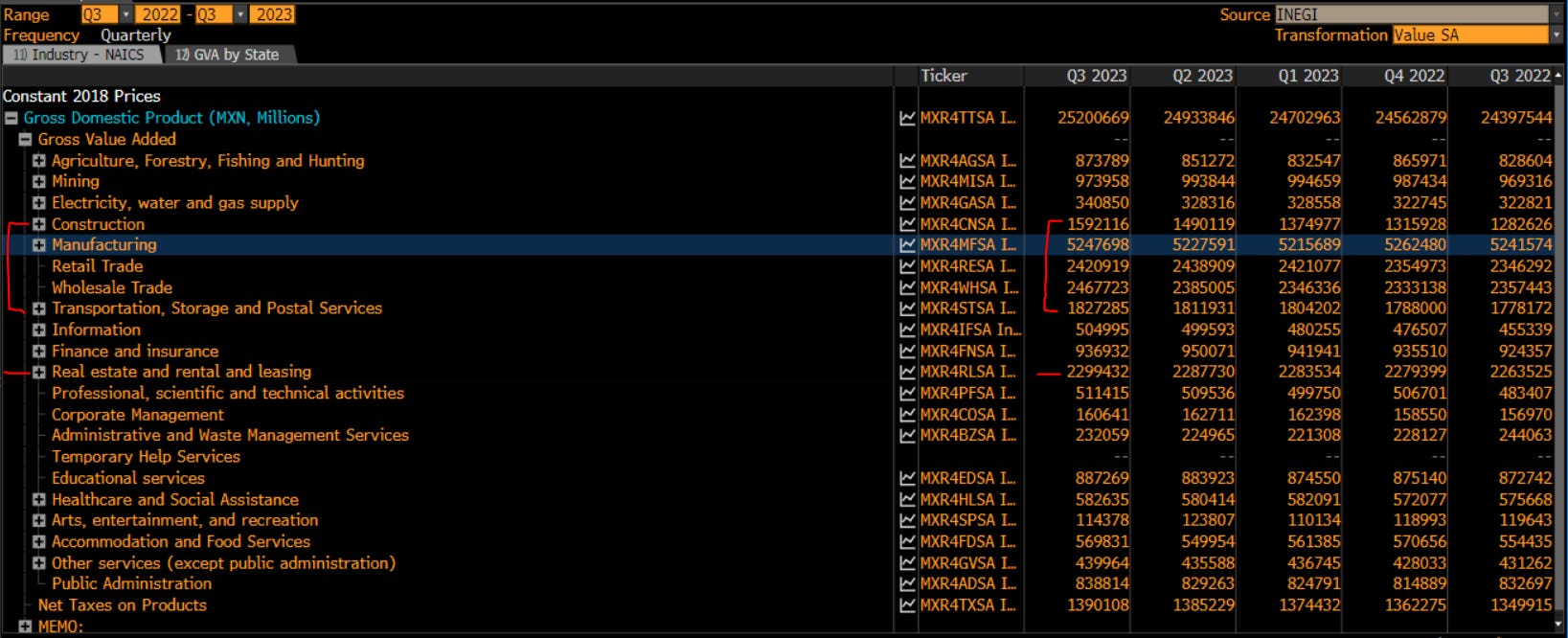
The largest contributors to GDP by industry are construction, manufacturing, transportation, and real estate:
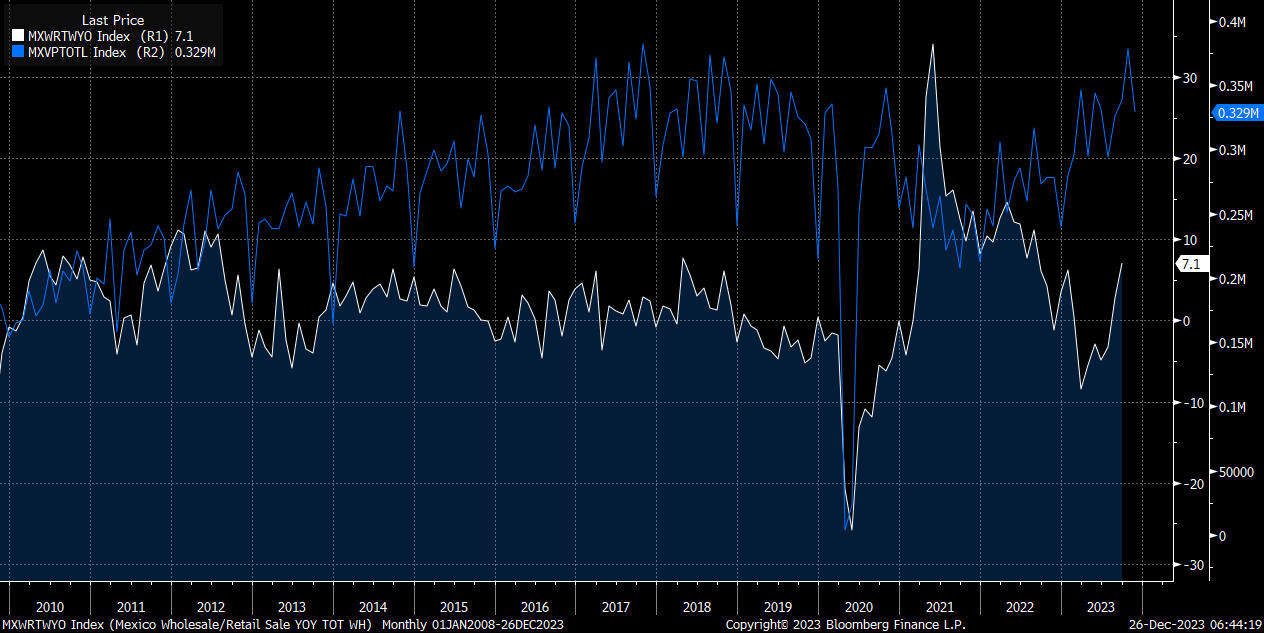
Given the industry contribution, watching wholesale data and vehicle production data is important for a macro view:
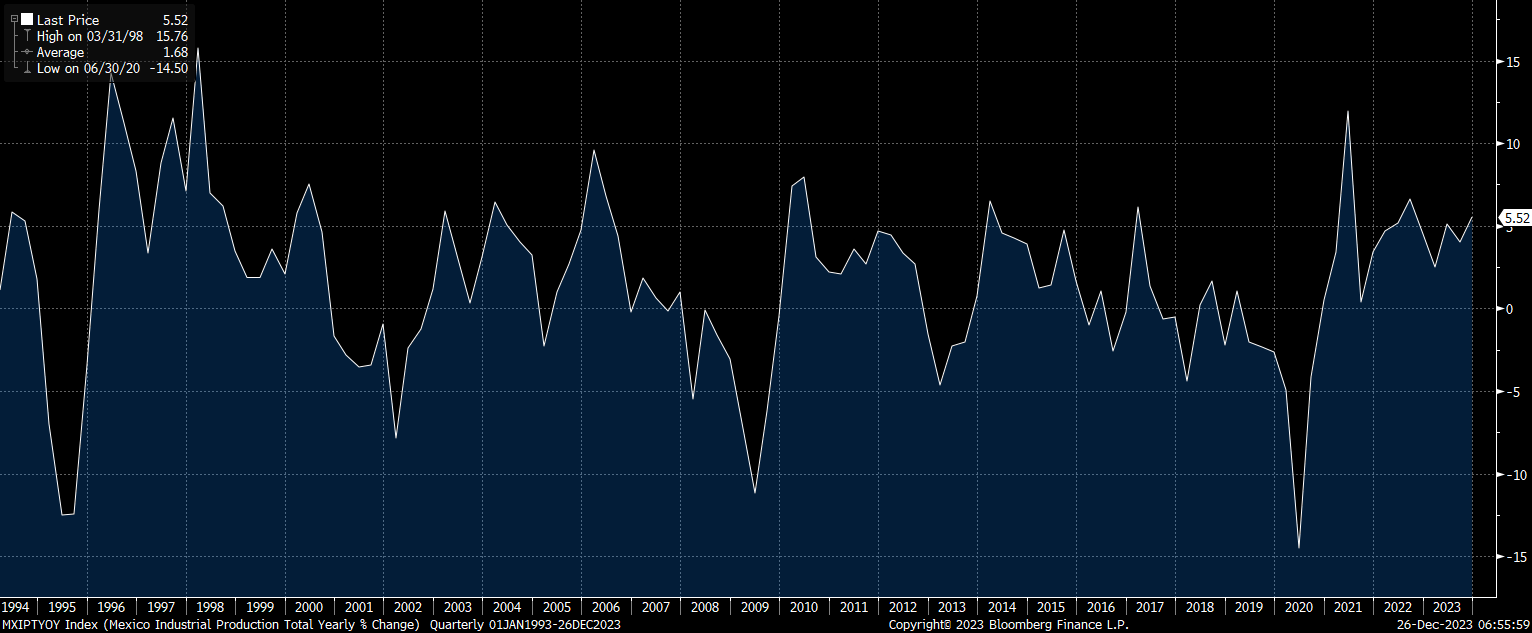
Industrial production and its connection with investment as well as the current account will be a key relationship to monitor. Notice the strength in industrial production post-COVID:
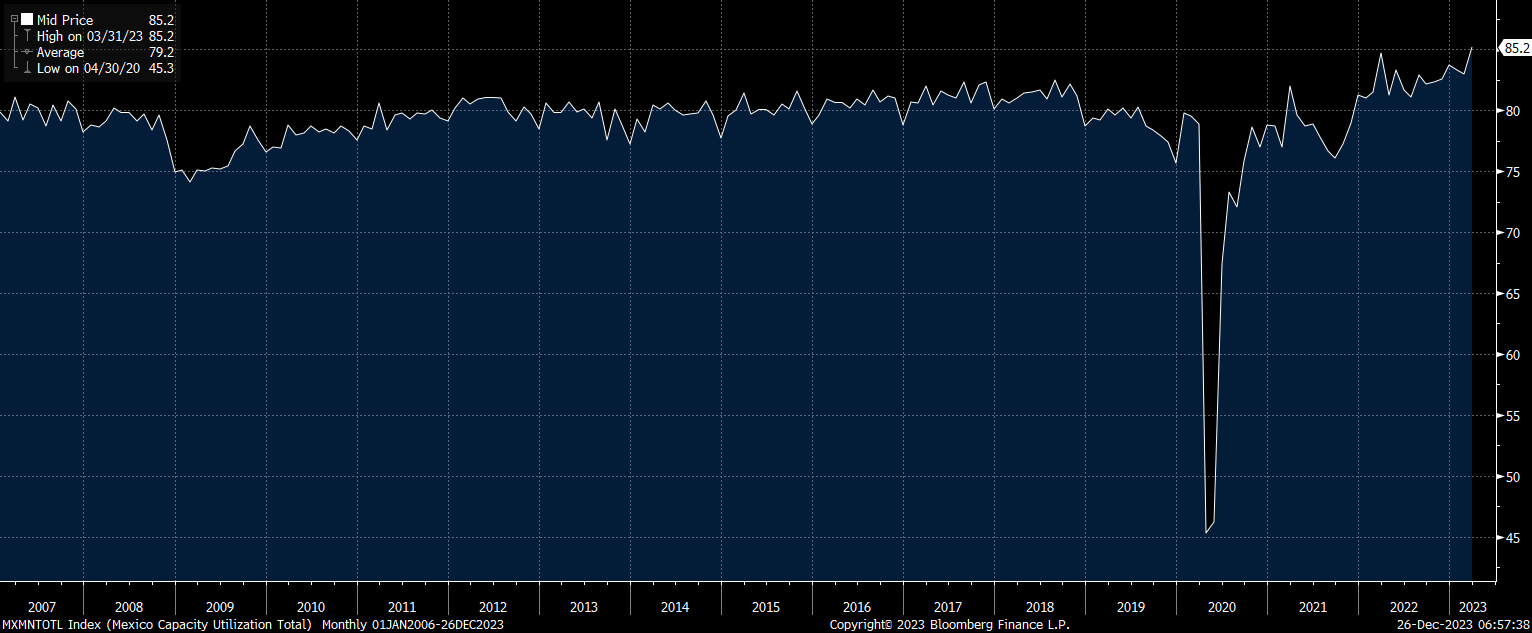
As capacity utilization rises, additional investment will need to take place to expand capacity and meet demand:
You can find all the economic data for Mexico here: Link and Link
Balance Sheets:
The balance sheet of agents in the Mexican economy is healthy and expanding:
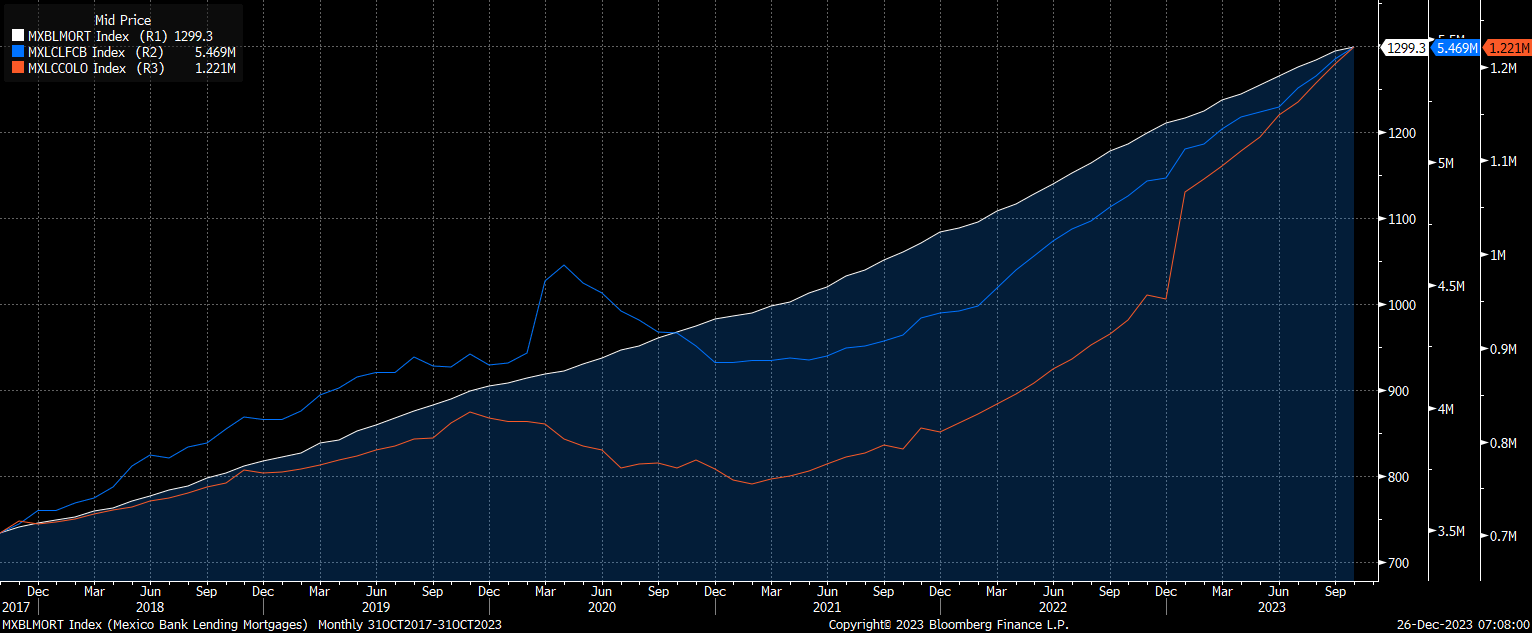
Mortgages outstanding (white), loans from commercial banks (blue), and consumer credit (orange) are all trending up:
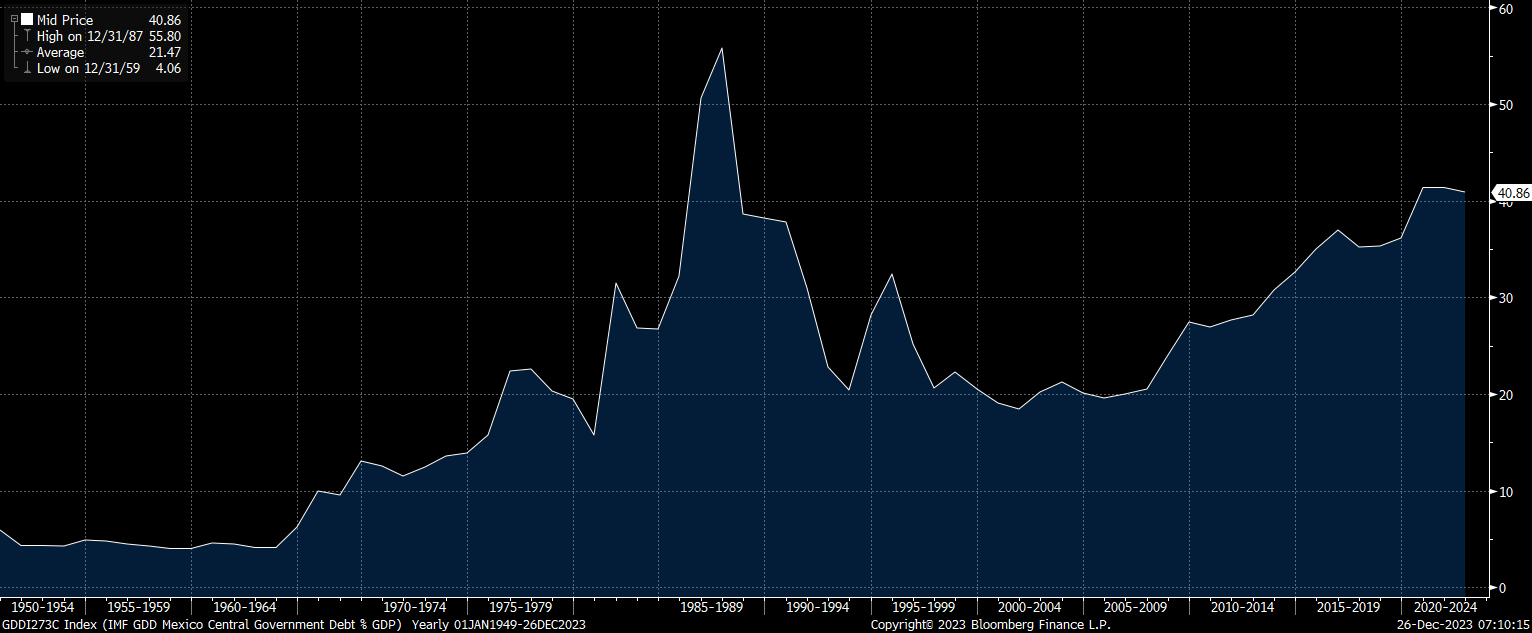
Government debt as a % of GDP is only 40%:
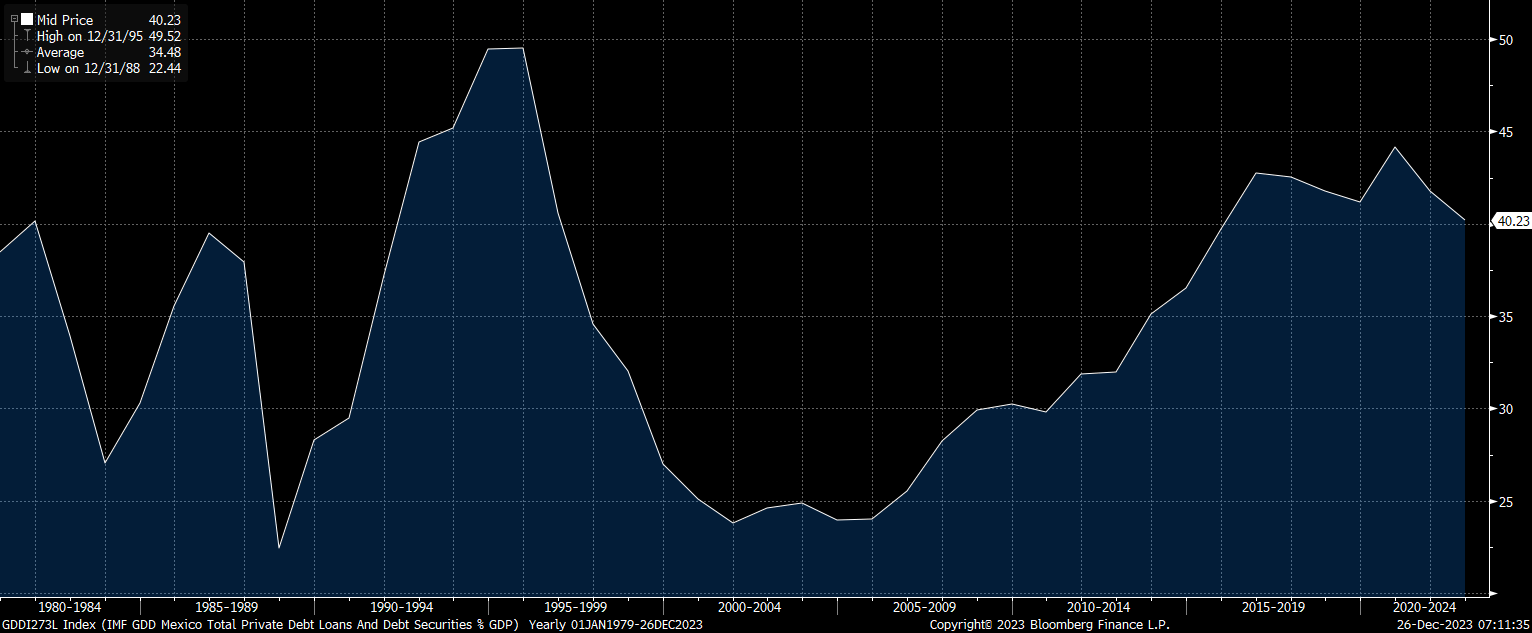
And private sector debt is similar:
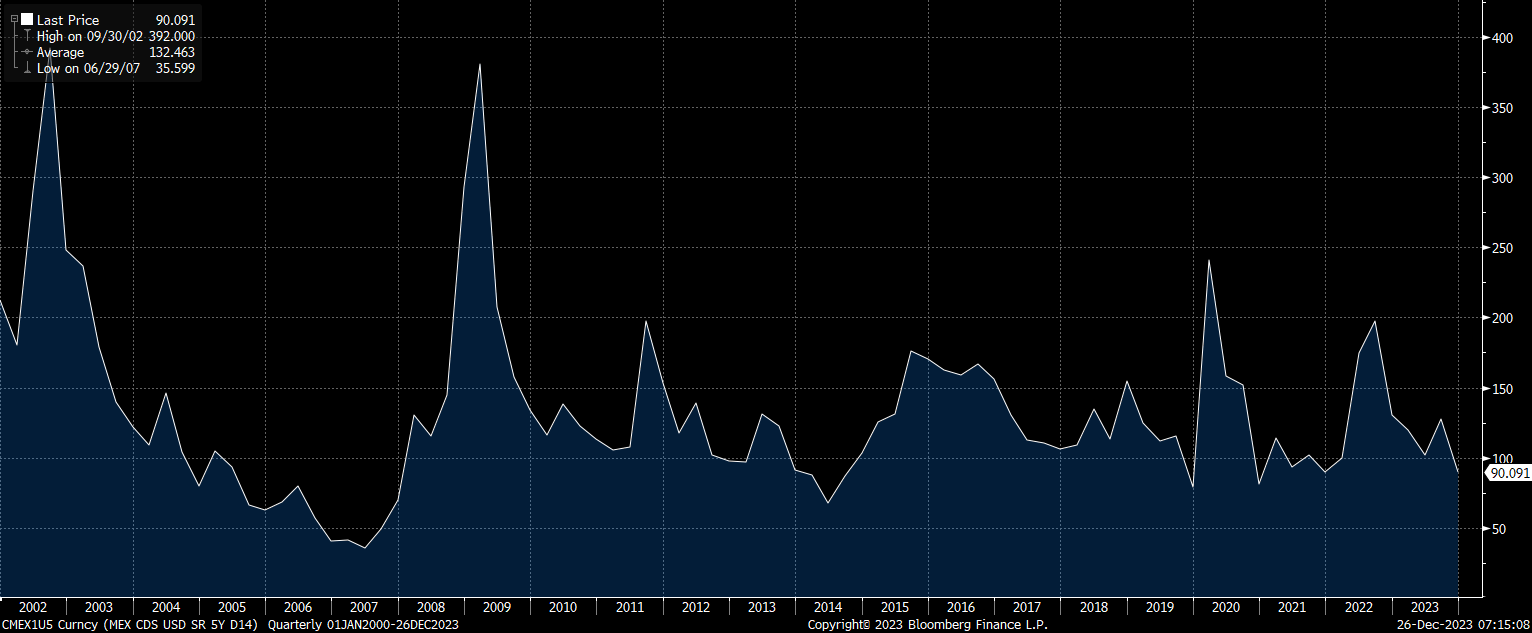
The Mexico CDS rose with typical risk-off moves during COVID and the 2022 hiking cycle but it is back at low levels:
As with many governments, the majority of the government debt is short duration but it is denominated in Pesos as opposed to dollars:
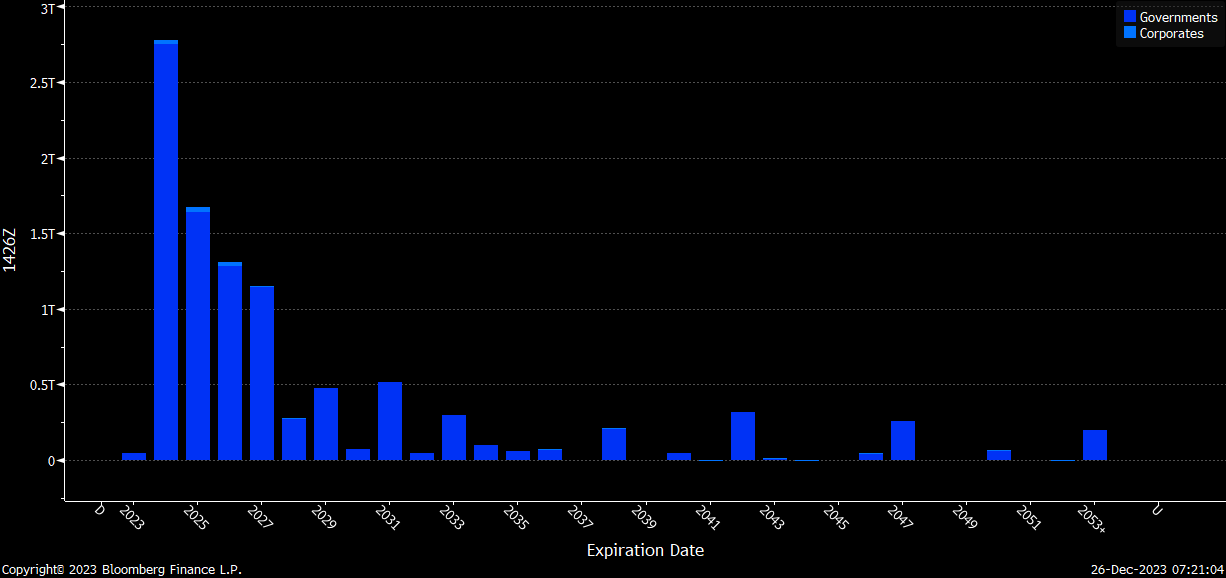
Dollar-denominated debt in Mexico is much smaller and has a longer duration:
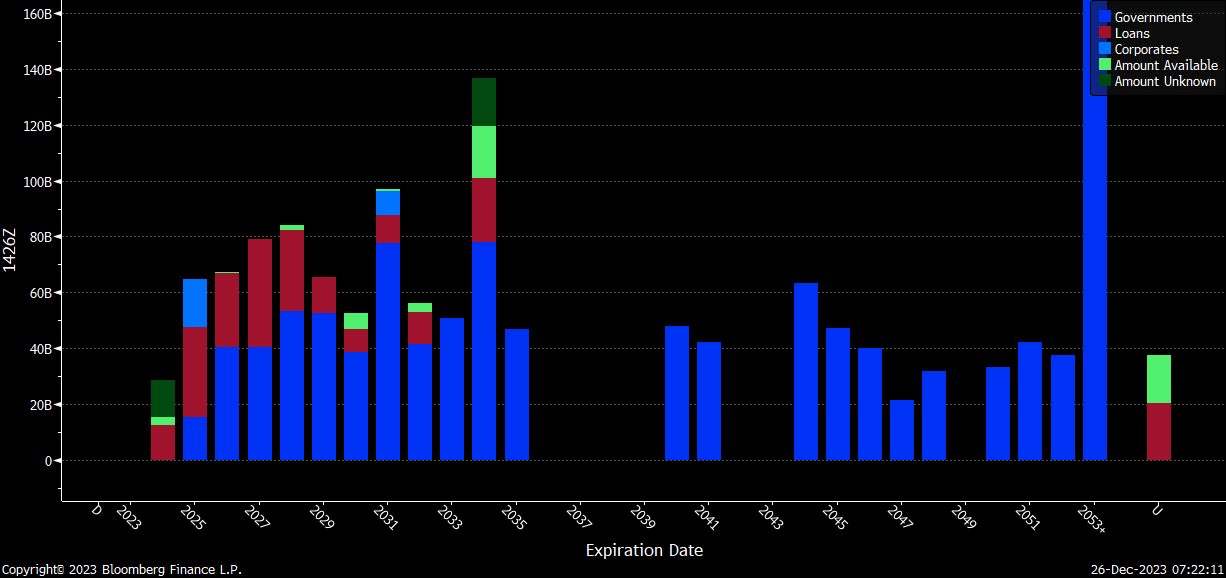
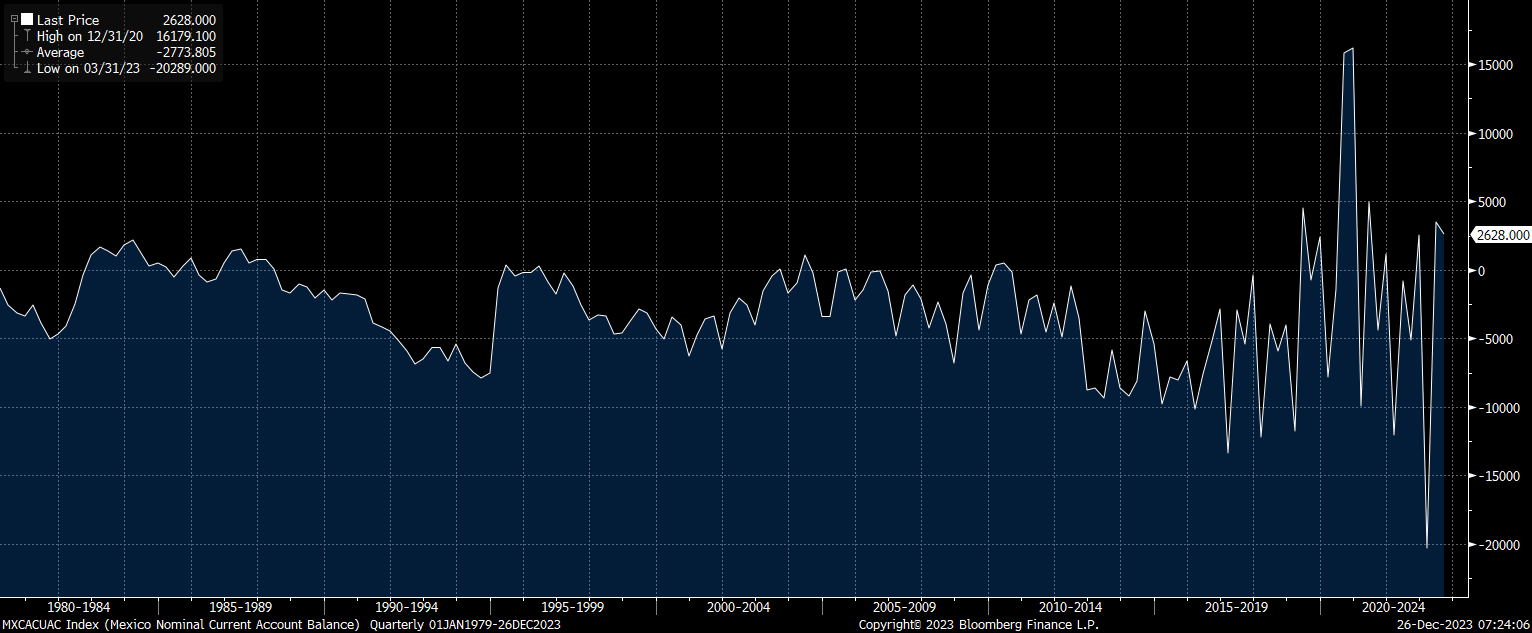
Mexico is likely to run a current account surplus as it invests in more output capacity for exporting goods to North America. This is likely to provide it with enough dollars to meet these future dollar-denominated obligations:
Inflation:
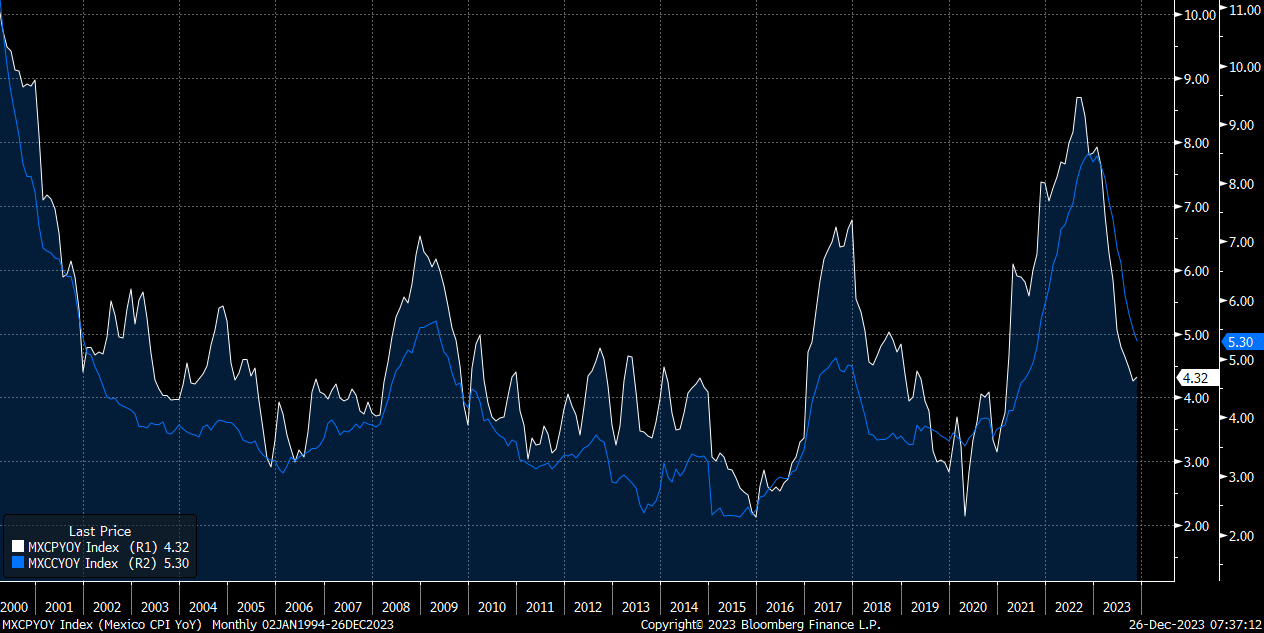
Inflation in Mexico has decelerated from its high:
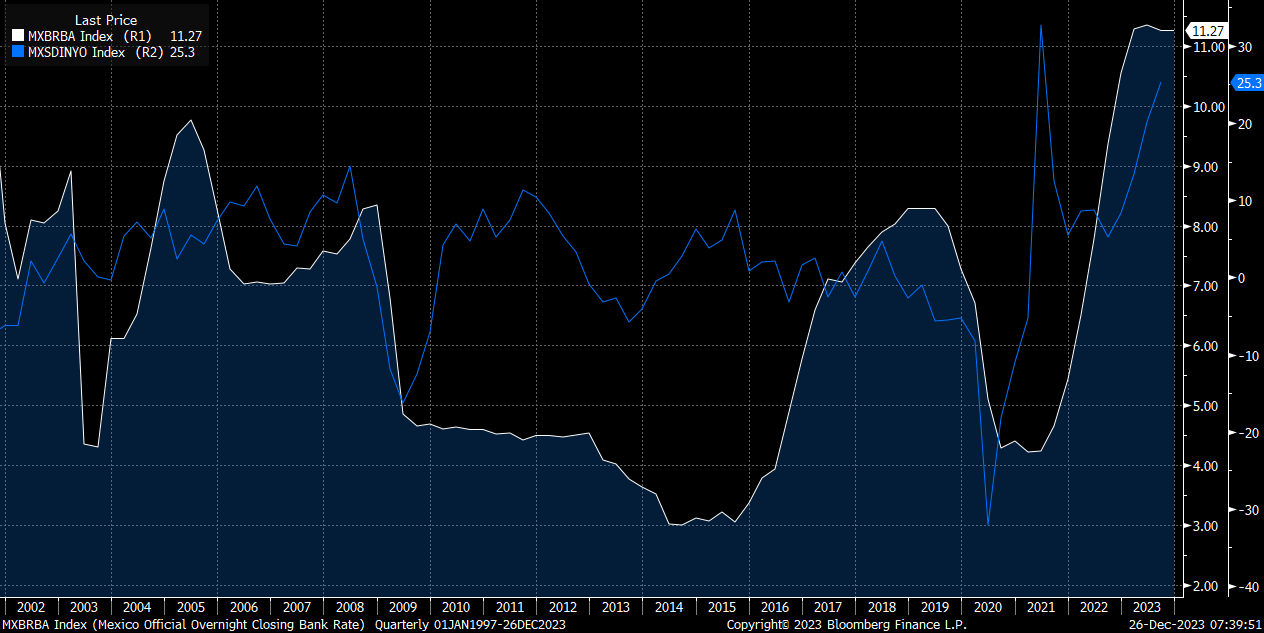
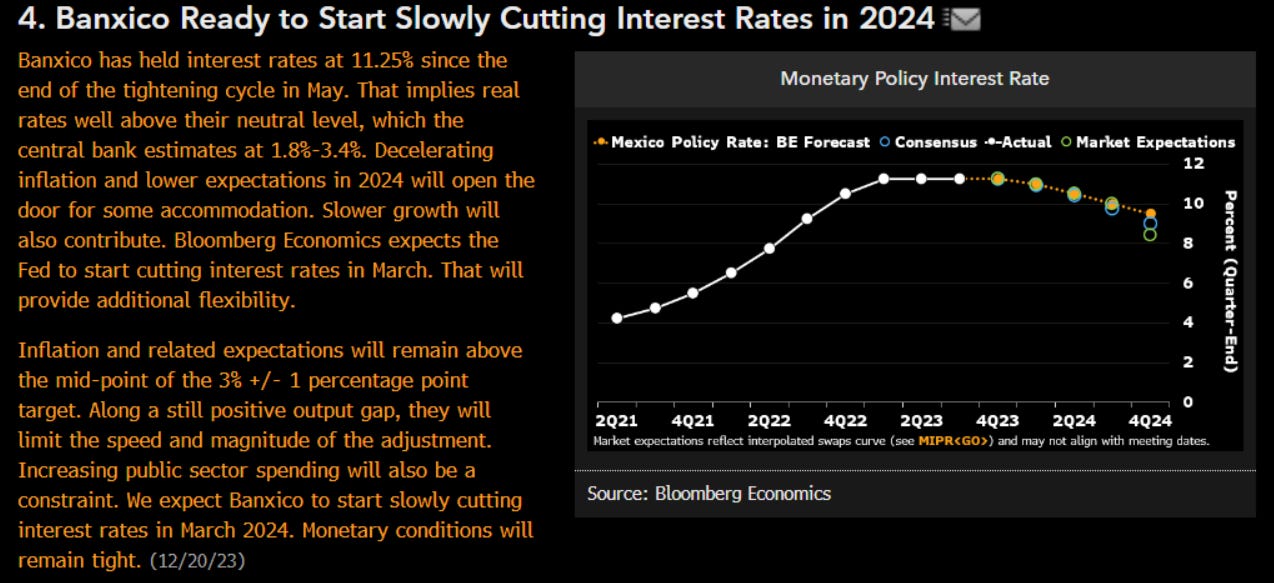
And the Bank of Mexico is holding its discount rate flat:
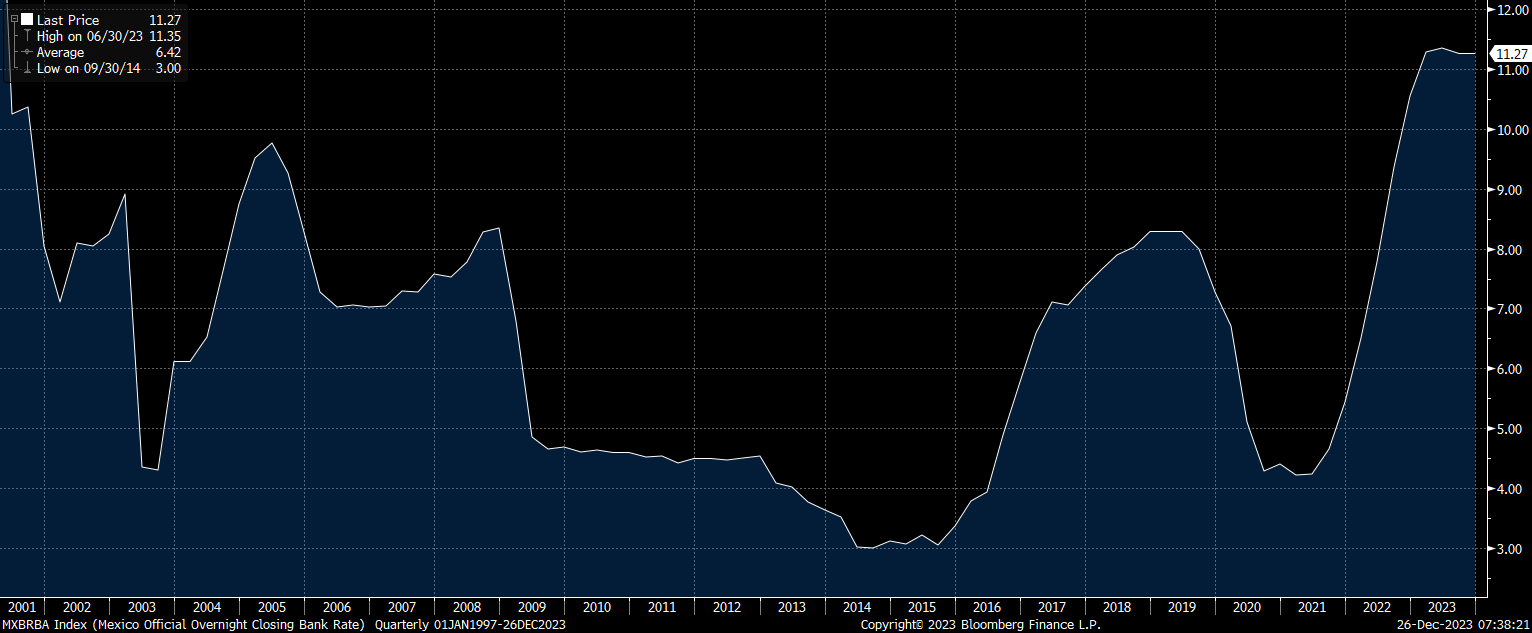
The key thing to note in this current regime is that investment has accelerated while the Bank of Mexico is hiking. Typically, the investment portion of GDP undergoes pressure when the central bank is hiking due to the higher levels of financing involved in investment. The fact that the investment line item of GDP has accelerated is likely an indication that the investment return is higher than the degree to which the discount rate is being increased.
In summary, there is an important context for Mexican economic data. Deglobalization shifts and geopolitical trends are pushing industrial bases and capital into Mexico. Mexico has a unique position within the global system from a geographic and demographic standpoint. This begins to frame the WHY behind the growth, inflation, and liquidity conditions in Mexico. Furthermore, it will provide significant visibility into how you analyze financial assets. Nothing trades in a silo and if you know what is happening in Mexican markets, you will have a clearer picture of what is happening in the rest of the world.
Financial Markets: Stocks, Bonds, and the Peso:
The way you break down financial assets in Mexico is very similar to how you break down assets in any country. However, you need to remember that every market is unique and there will always be different variables you need to account for. On a fundamental basis, the causal mechanics are the same. If you understand the causal mechanics of what drives asset markets in general (and not simply a siloed experience from the US), you will pick it up very fast.
There is one main idea that you will begin to see: Global markets are ALL connected. The same people who trade US assets also trade Japanese assets. The PM managing risk in the Magnificent 7 stocks could be a Mexican hedge fund manager balancing risk in their corporate bond book that is denominated in Pesos. Just because you might trade assets in a silo doesn’t mean that is how the world works.
Just keep in mind that as Mexico becomes more integrated with the US and other countries, correlations will begin to increase in both economic data and financial assets.
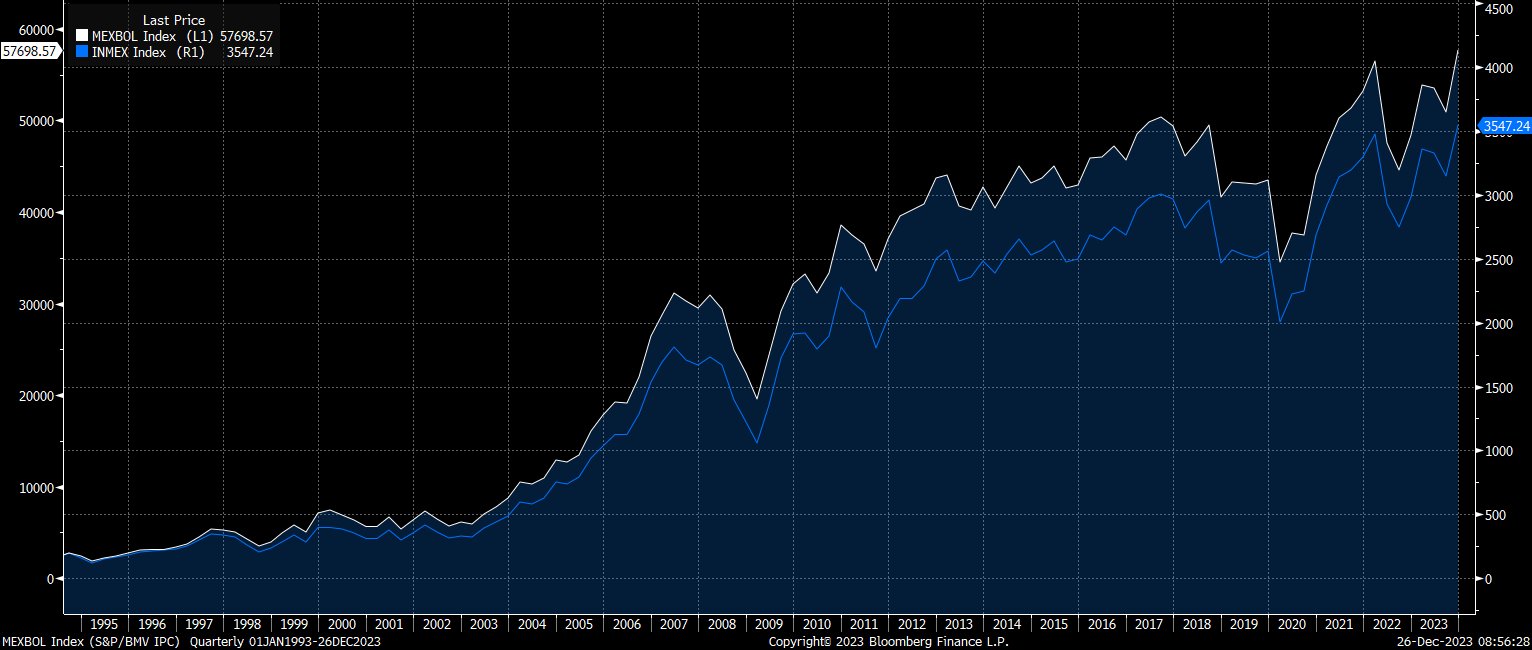
There are two major equity indices in Mexico: the IPC and INMEX index.
The IPC index:

INMEX Index:

These indices track with each other fairly well:
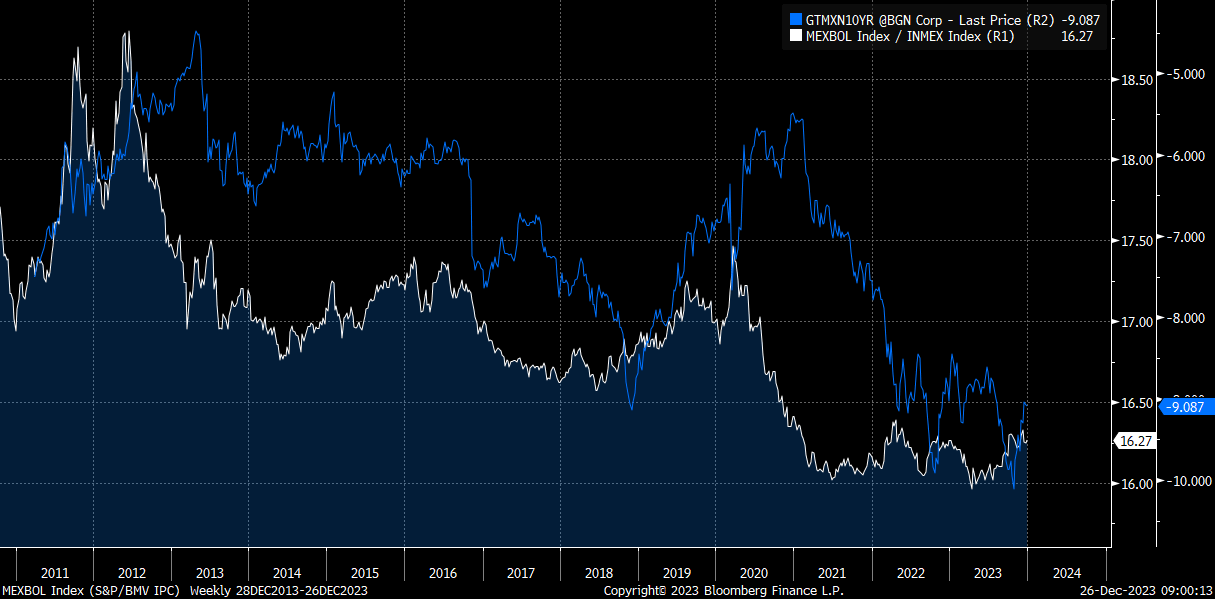
The ratio of these indices has a marginal correlation to Mexican interest rates (inverted in blue) due to the weightings of the underlying sectors:
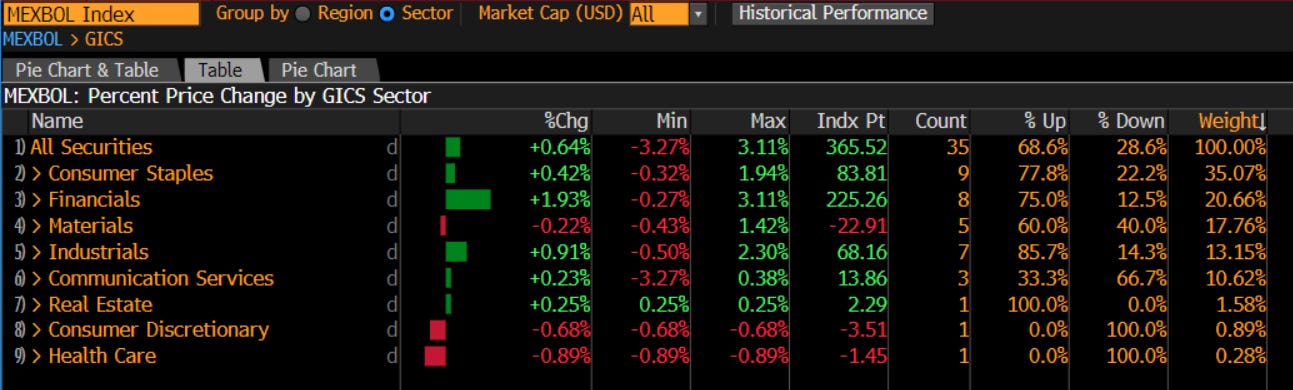
The sector weighting for the IPC Index:
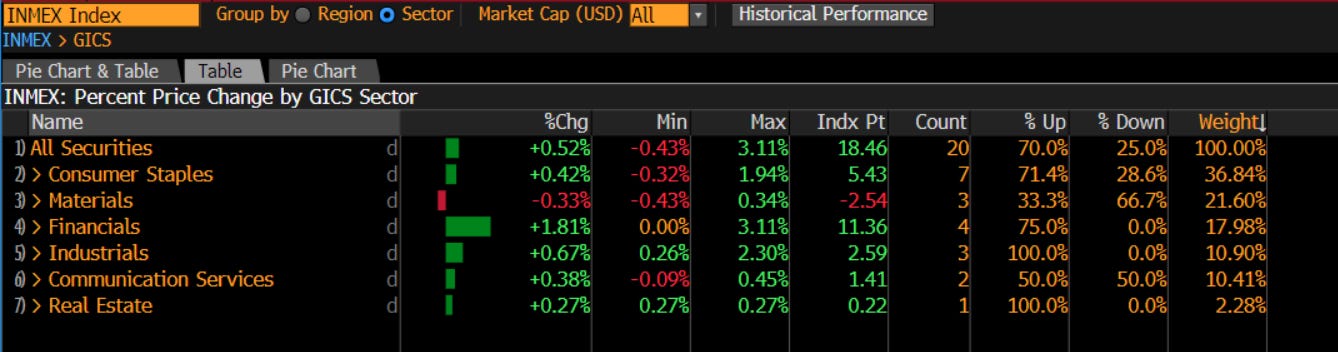
Sector weightings for the INMEX Index:
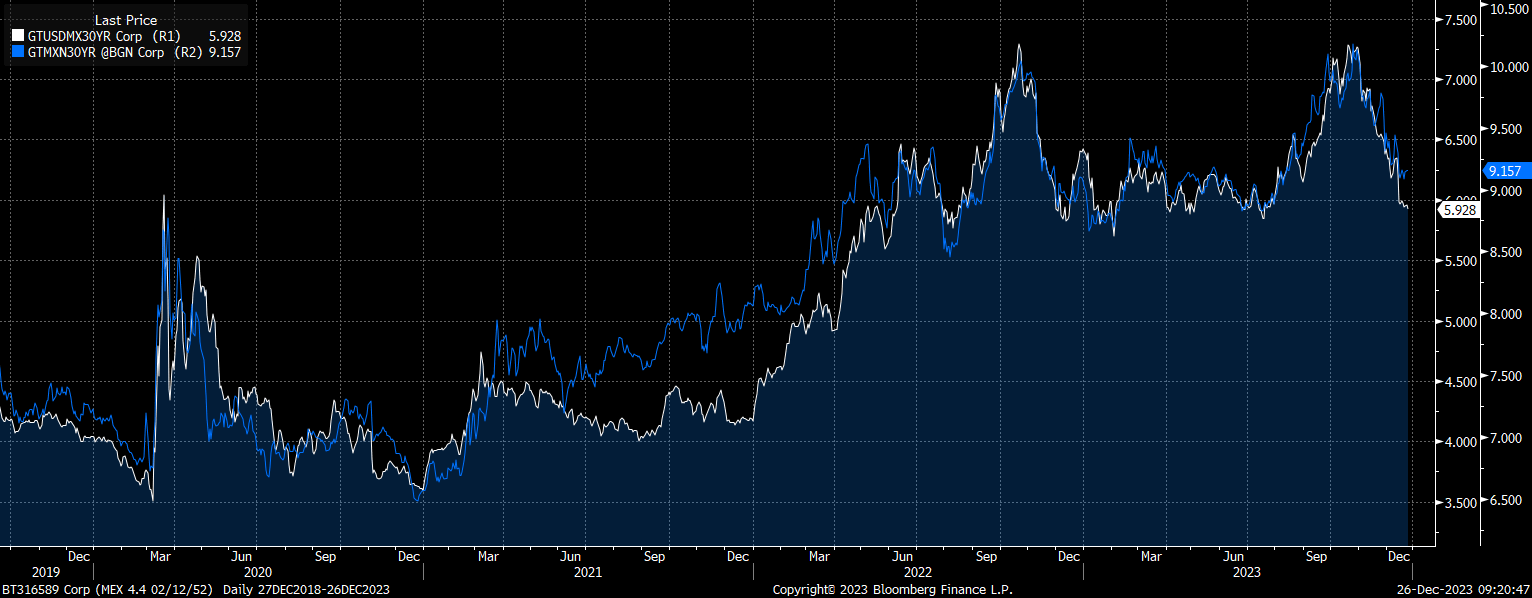
Peso-denominated and USD-denominated bonds are moving in lockstep but typically have some type of spread:
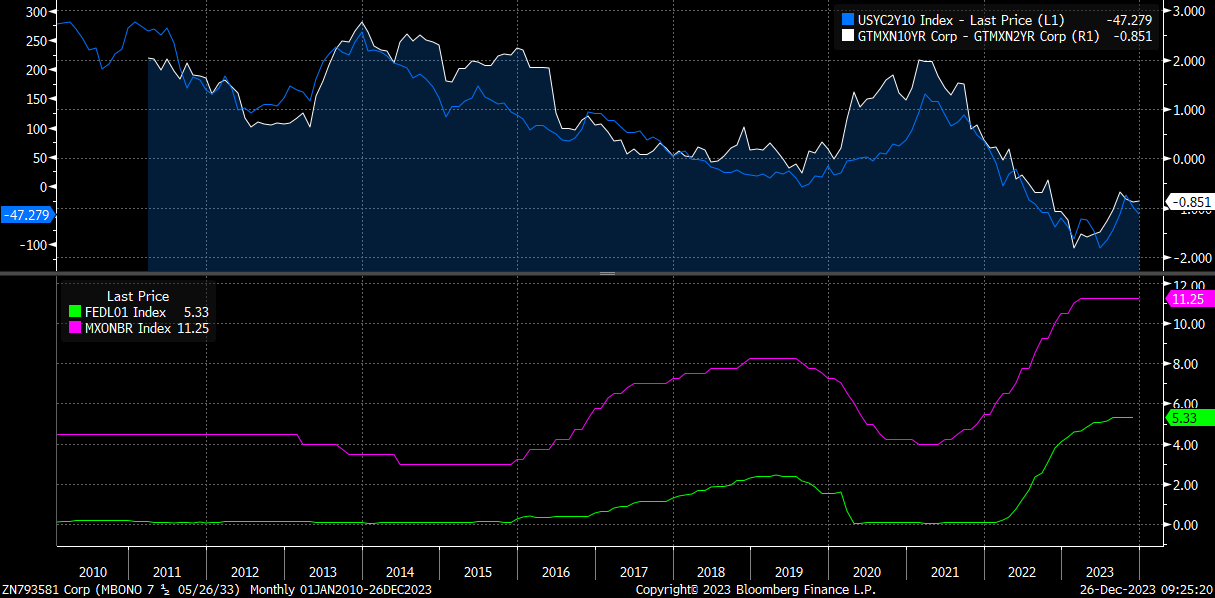
The yield curves and discount rates typically move in lockstep with the US:
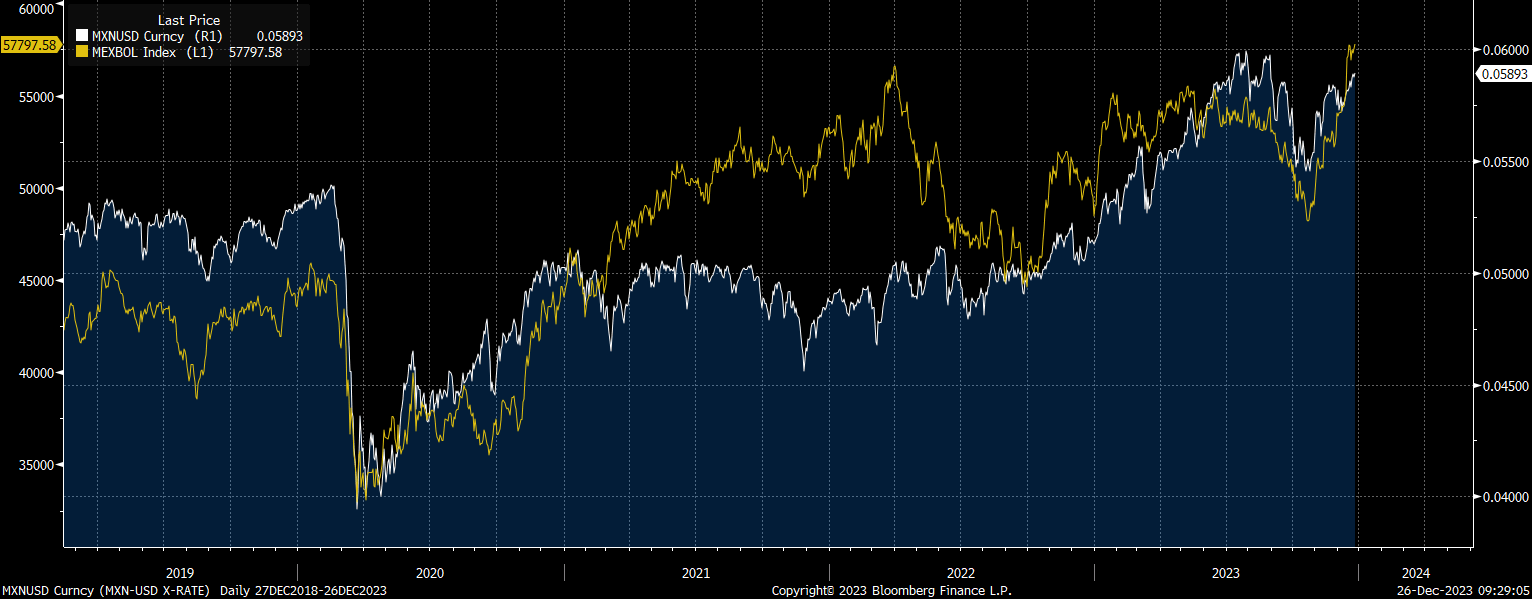
The main thing to take note of is the currency. The Peso has continued to make highs with stock indices. This is a key signal because it shows the fundamental backing for the rally:
Nominal rate differentials between Mexican rates and US rates are moving in lockstep with the exchange rate as well:
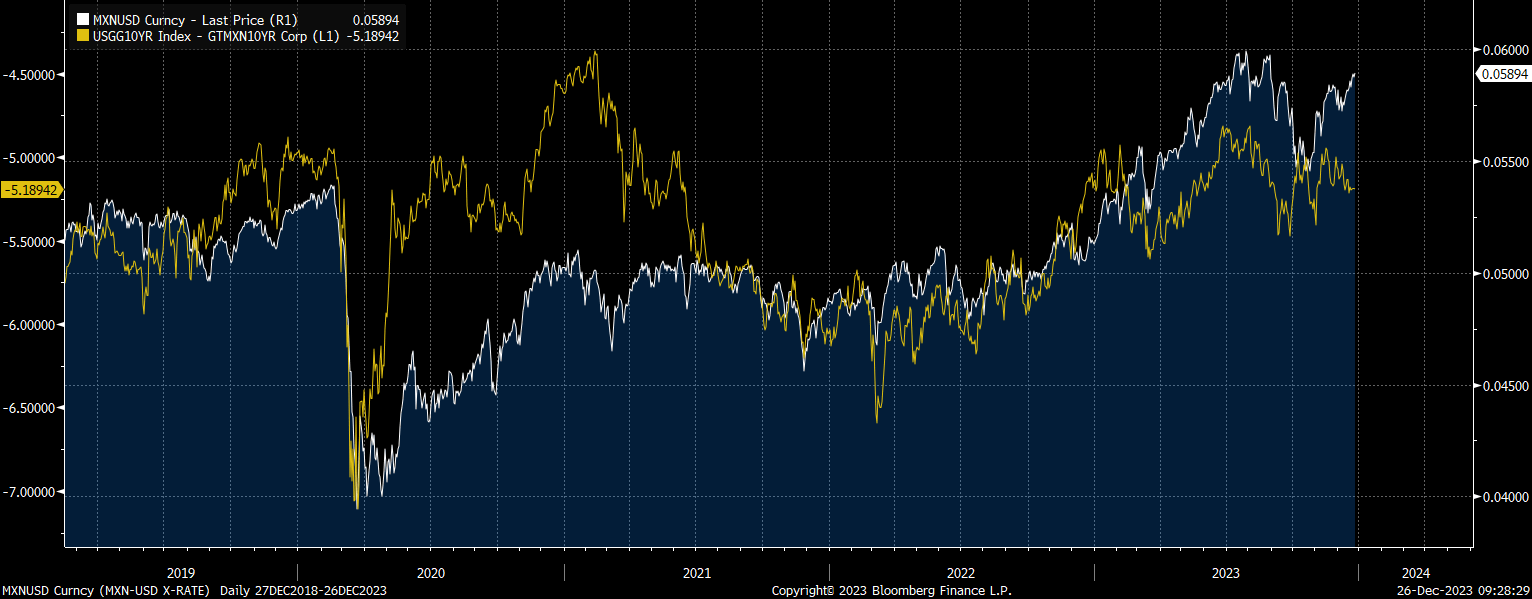
Watching the Peso and nominal rate differentials as they connect with fundamental data will be key in identifying WHEN stocks over-extrapolate expected returns. Here is the index with earnings expectations. Watching these data points as we move through the economic calendar will provide visibility into how expected returns are being realized:
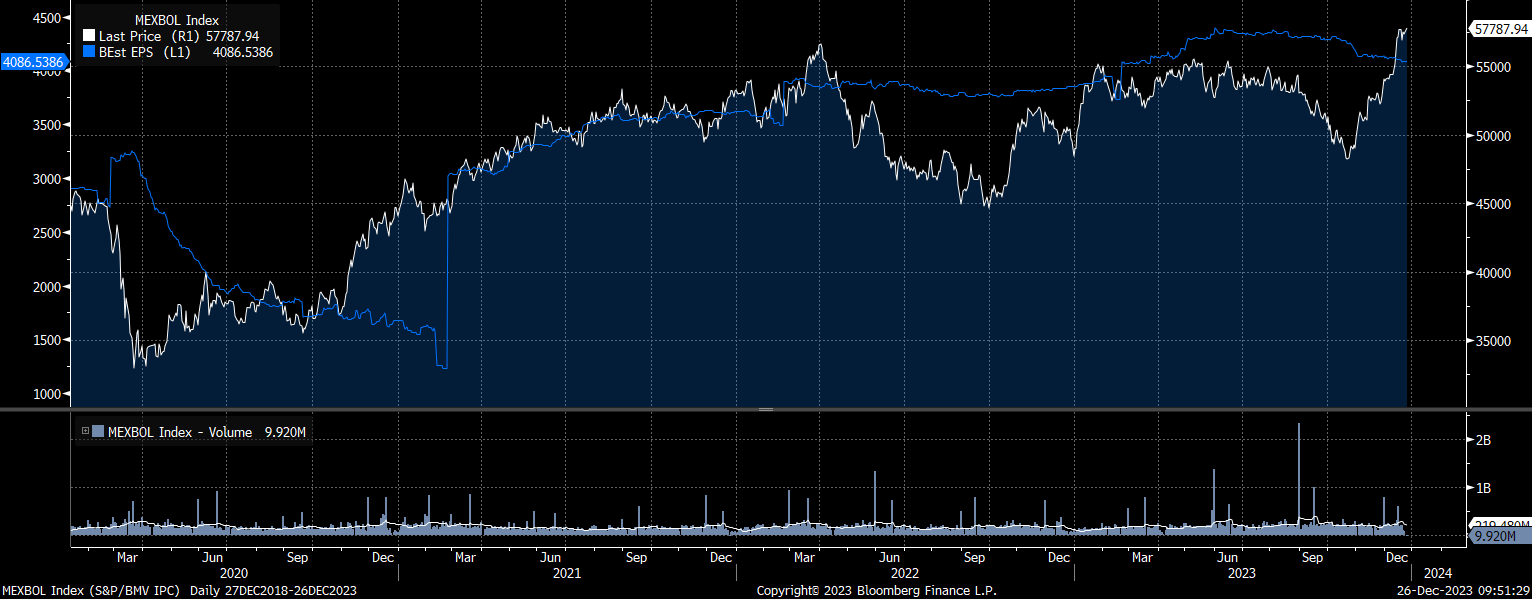
Main idea: The primary thing to monitor is Mexico’s current account and capital account in connection with trade developments. For the persistence of a structural bull market in the Mexican economy, you need the persistence of foreign manufacturing to take place in Mexico AND foreign capital to make investments. This economic reality will be reflected in financial markets by strong earnings, positive returns in equities, and a strong Peso. If we see a strong Peso and bullish equities, any move down in nominal rates due to a shift in the Bank of Mexicos stance will likely further fuel the rally.
This brings us to a word of caution from Mexico’s history.
History of growth, inflation, and liquidity on a structural and cyclical basis:
The main event you need to think about in Mexico’s history is the “Tequila Crisis.”
Technical Breakdown:
The Tequila Crisis, which unfolded in Mexico in 1994-1995, was a financial turmoil that had profound impacts on the Mexican economy, particularly in the financial markets, the stance of monetary policy, and trade. The crisis began in the context of Mexico's growing financial liberalization and rapid integration into global capital markets during the early 1990s. This period saw a significant influx of foreign investment into Mexican financial markets, buoyed by high-interest rates and the expectation of stability and economic growth. However, underlying vulnerabilities, including a fixed exchange rate regime, large current account deficits, and reliance on short-term foreign capital, set the stage for instability. Speculative attacks on the peso, political uncertainties, and concerns about the sustainability of Mexico's economic policies led to massive capital outflows and a severe drop in investor confidence.
The Bank of Mexico's monetary policy response to the unfolding crisis was a crucial element in its progression. Initially, the central bank maintained a fixed exchange rate with the US dollar, trying to use its foreign exchange reserves to defend the peso. However, this strategy was unsustainable given the magnitude of capital flight and the rapid depletion of reserves. In response to these pressures, the Bank of Mexico devalued the peso in December 1994, a move that failed to restore confidence and instead triggered a steeper devaluation and inflationary pressures. To combat inflation and stabilize the currency, the central bank shifted to a tight monetary policy, significantly increasing interest rates. While this move was necessary to regain monetary control, it also contributed to a deep economic recession, with substantial impacts on credit, investment, and overall economic activity.
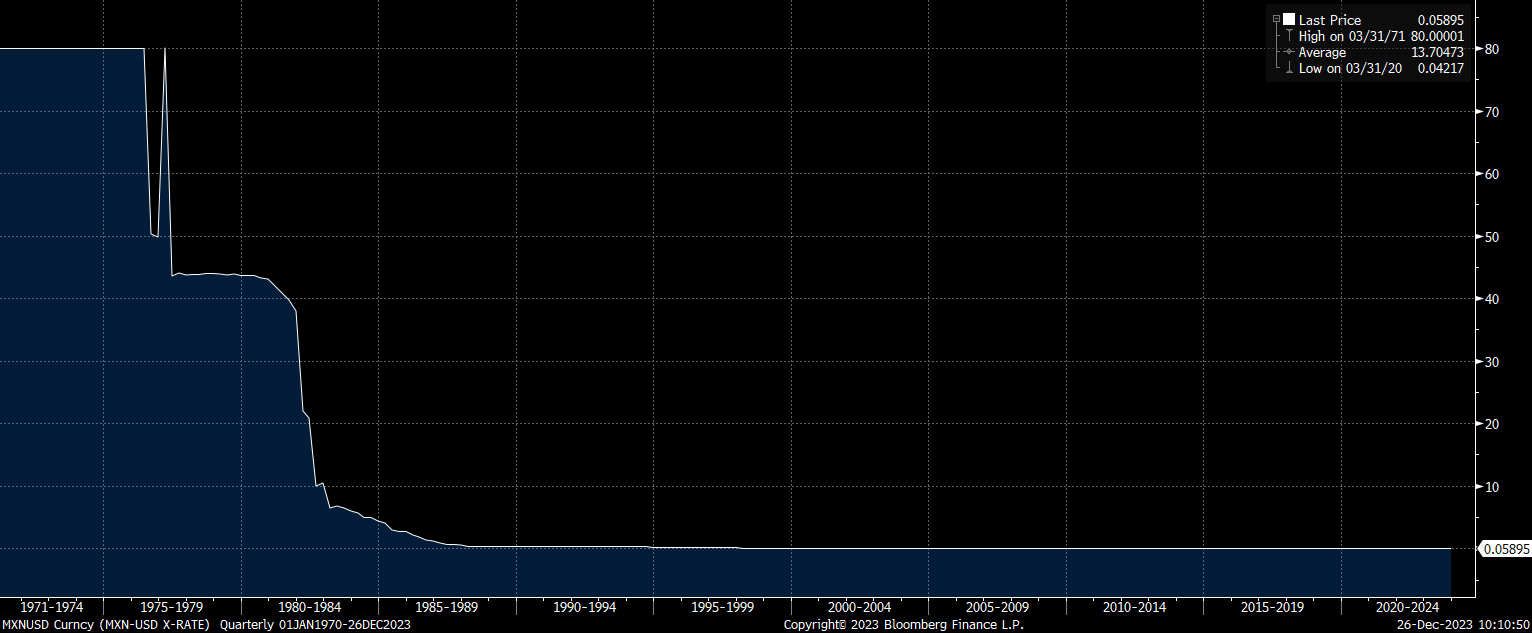
The Tequila Crisis had profound implications for trade and the value of the peso. The sharp devaluation of the peso made Mexican exports cheaper and more competitive, which, in theory, could benefit trade. However, the immediate effect was negative due to the crisis of confidence, which led to a reduction in foreign investment and a slowdown in economic activity. Moreover, the devaluation significantly increased the cost of imports, contributing to inflation and reducing the purchasing power of Mexican consumers. In the longer term, the crisis led to a restructuring of the Mexican economy, including changes in trade policies and a move towards more flexible exchange rate regimes. The crisis also highlighted the risks of short-term debt and led to increased scrutiny of emerging market vulnerabilities by international investors and institutions, prompting reforms in financial regulation and economic policy both in Mexico and internationally.
(Long-Term Chart of Inflation)
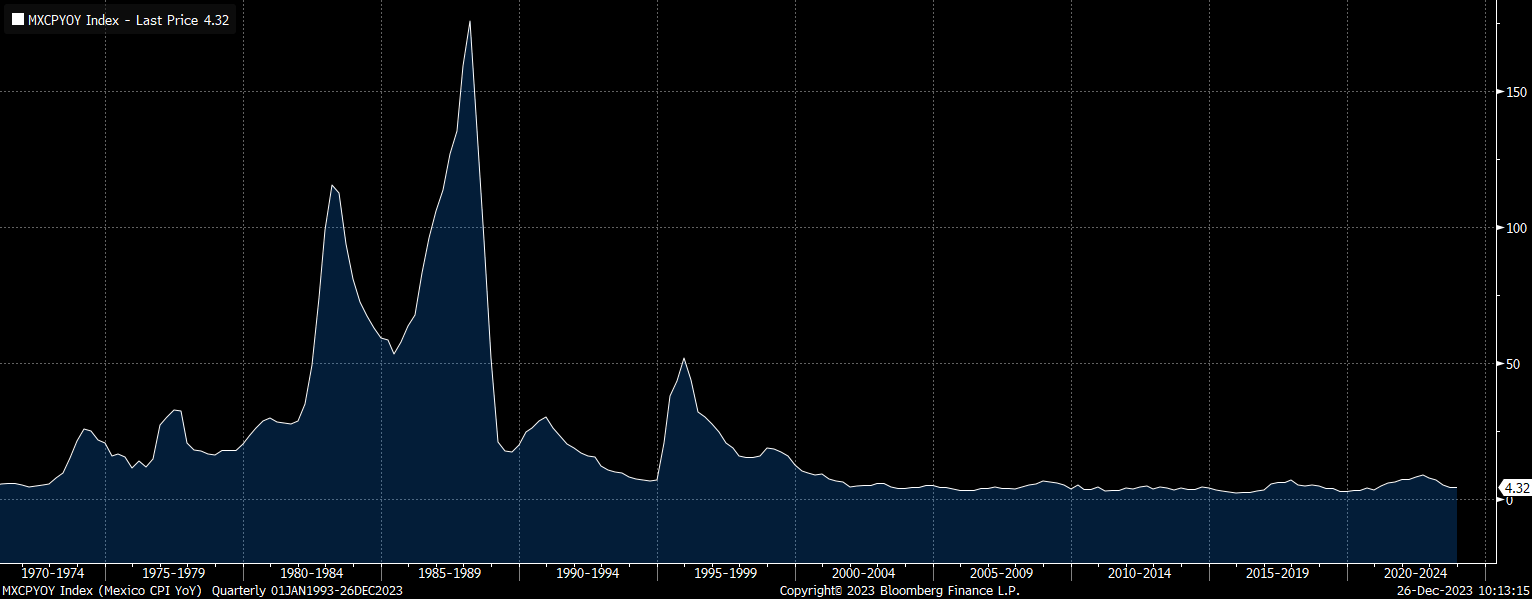
The main idea to keep in mind from the Tequila Crisis is that any situation can lose its stability. This is why understanding the underlying drivers of a situation is critical for extracting returns in financial markets. Mexico has a bright future but that doesn’t mean it is without risks. Just remember, the Tequila Crisis was preceded by exceptional returns that you wouldn't want to miss. Like Soros said, you want to be long bubbles.
Current growth, inflation, and liquidity regime and its connection to each financial asset:
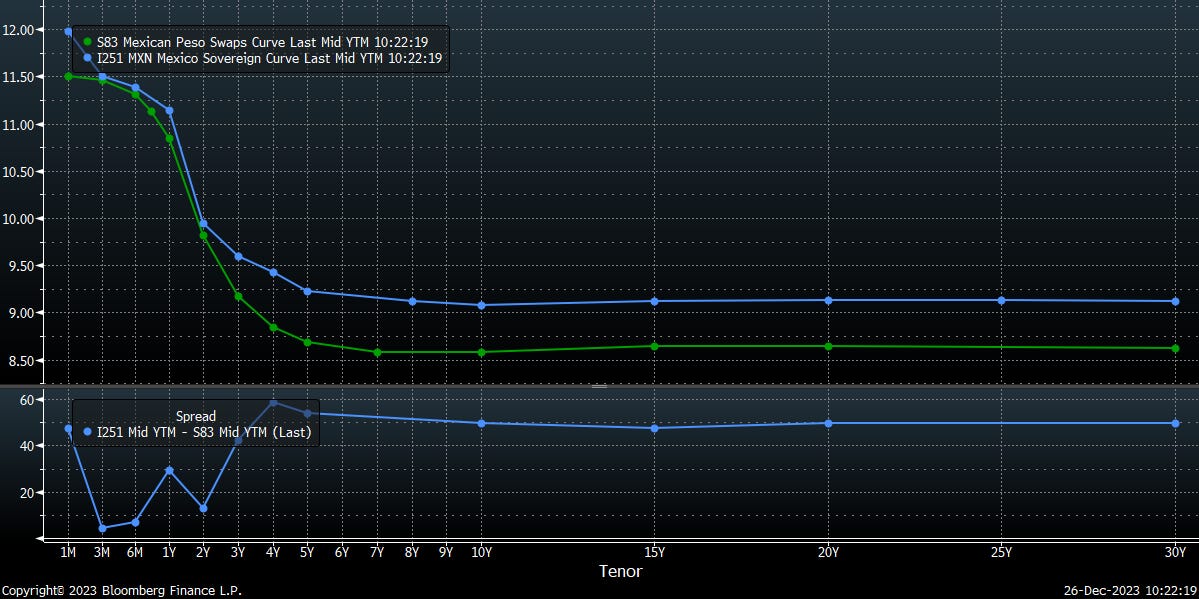
Mexico is currently in a regime where growth is positive, inflation is decelerating and the central bank is holding rates at an elevated level.

The Peso swaps curve and sovereign curve are both sloping down:
Monetary Policy Announcement
Press Release December 14, 2023
The Governing Board of the Bank of Mexico has decided to maintain the target for the overnight interbank interest rate at 11.25%.
The available information suggests that, in the fourth quarter of 2023, global economic activity would have slowed down, although it remains resilient. General inflation continued to decrease in most economies, although it remains above the targets of their central banks. The core component registered more gradual reductions than general inflation. The central banks of major advanced economies kept their benchmark rates unchanged. Sovereign interest rates decreased globally, and the US dollar registered a generalized depreciation, in an environment of lower risk aversion. Among the global risks are the prolongation of inflationary pressures, the worsening of geopolitical tensions, tighter financial conditions, and, to a lesser extent, challenges to financial stability.
In Mexico, interest rates on government securities decreased, mainly in medium and long terms, in line with the behavior of international financial markets. The Mexican peso appreciated slightly. The economy has maintained robust growth, and the labor market continues to show strength.
Since the last monetary policy meeting, the annual general inflation exhibited a certain increase. In November, it was at 4.32%, due to an increase in the non-core component. Core inflation continued to decline, although it remained at high levels, reaching 5.30% in the same month. Expectations for year-end 2023 inflation decreased for general inflation, while those for core inflation increased. Longer-term expectations remained relatively stable at levels above the target.
Looking ahead, the disinflationary process is expected to continue, due to the stance of monetary policy and the mitigation of shocks derived from the pandemic and the war in Ukraine. However, updated forecasts incorporate a more gradual decrease in food and service commodity inflations. For this reason, forecasts for general and core inflation are revised upwards for some quarters. It is still anticipated that inflation will converge to the target in the second quarter of 2025 (see table). These forecasts are subject to risks. On the upside: i) persistence of high core inflation; ii) currency depreciation; iii) greater cost pressures; iv) the economy showing more resilience than expected; and v) pressures on energy or agricultural prices. On the downside: i) a greater slowdown in the global economy than anticipated; ii) a lesser pass-through of some cost pressures; and iii) that the lower levels of the exchange rate compared to the beginning of the year contribute more than anticipated to mitigating certain inflationary pressures. The balance of risks regarding the forecasted inflation trajectory over the forecast horizon remains skewed to the upside.
The Governing Board evaluated the magnitude and diversity of inflationary shocks and their determinants, as well as the evolution of medium and long-term expectations and the price formation process. It recognized that the disinflationary process has advanced in the country. However, it estimated that the outlook still poses challenges. Based on the above and considering the already achieved monetary stance and the persistence of the shocks faced, the Governing Board, with all its members present, unanimously decided to maintain the target for the overnight interbank interest rate at 11.25%. With this decision, the monetary policy stance remains on the trajectory required to achieve the convergence of inflation to its 3% target within the forecast horizon.
The Governing Board will closely monitor inflationary pressures, as well as all factors affecting the expected inflation trajectory and its expectations. It considers that, to achieve an orderly and sustained convergence of general inflation to the 3% target, it will be necessary to maintain the benchmark rate at its current level for some time. This takes into account that, although the outlook is still perceived as complicated, progress has been made in the disinflationary process. The central bank reaffirms its commitment to its primary mandate and the need to persevere in its efforts to consolidate a low and stable inflation environment.
If inflation maintains its current path, we are likely to see some cuts in 2024, especially if other major central banks lead the way:
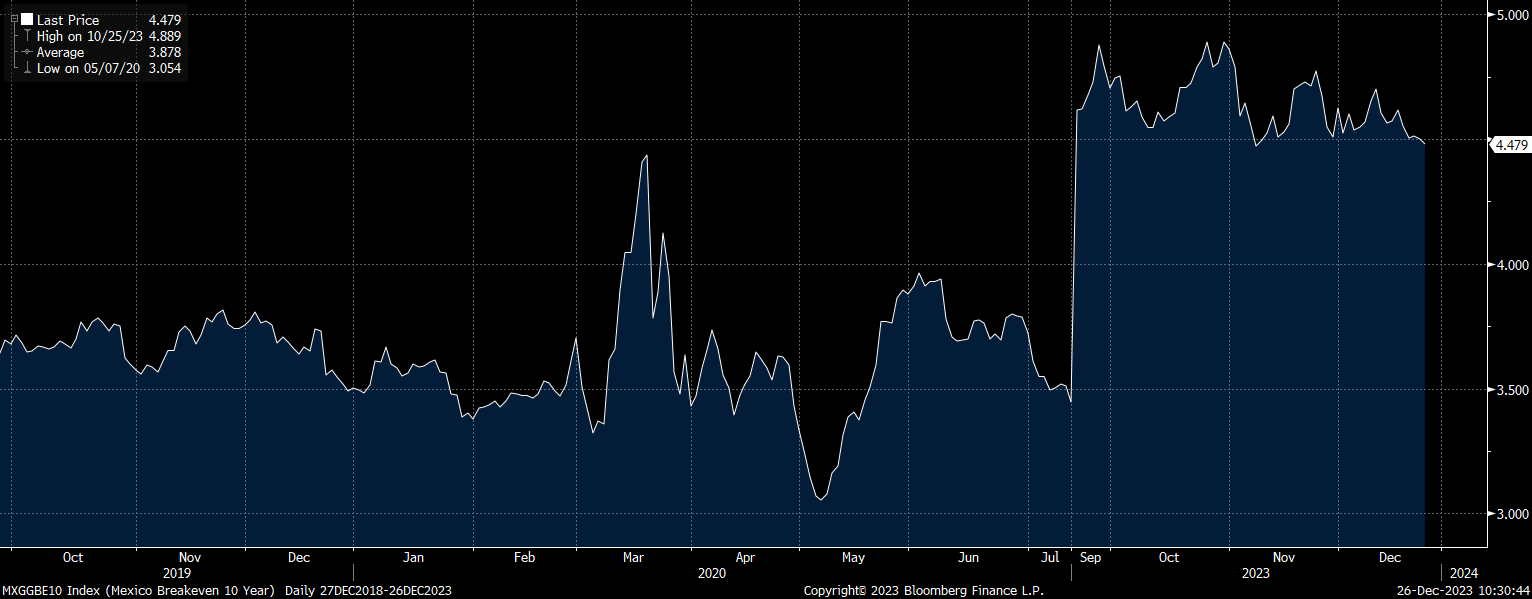
10-year breakevens are still elevated and would need to make a pronounced move down for clearer confirmation of cuts:
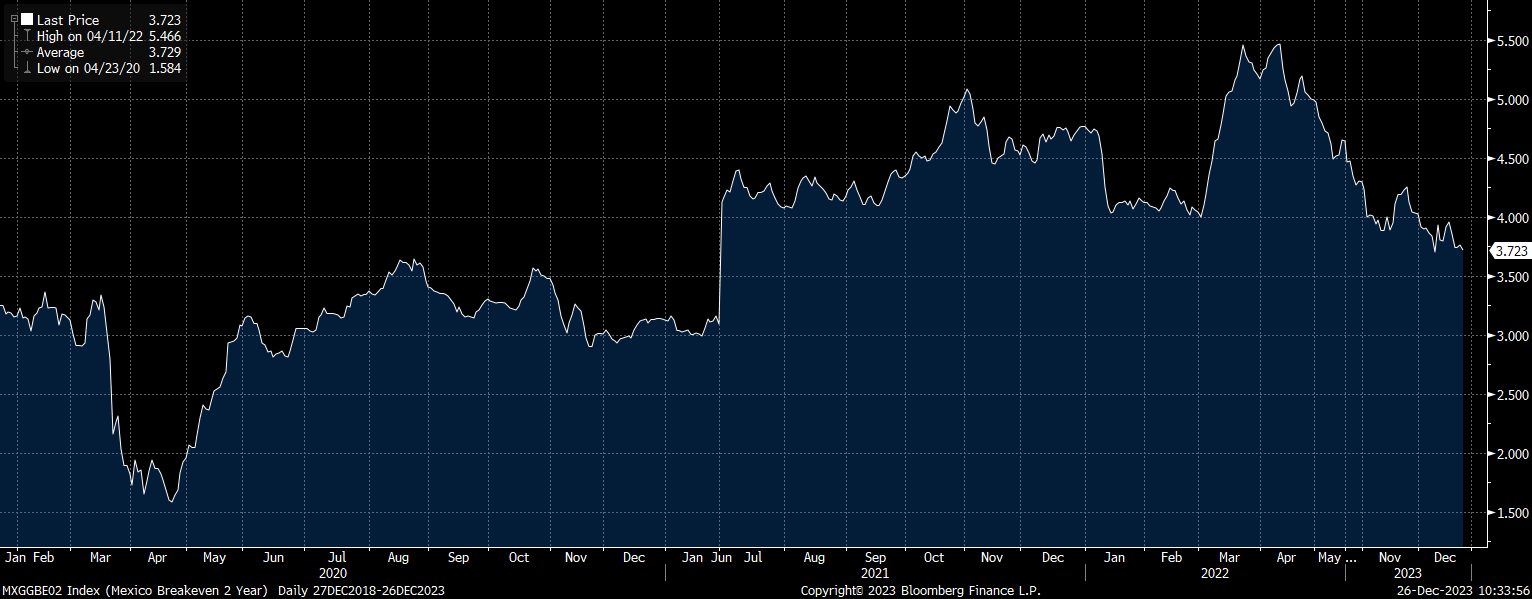
2-year breakevens are already trending down:
2y2y Swaps (white) are pricing in a downward direction for 2-year nominal rates (blue). The primary question is about the SPEED of the Bank of Mexico in their actions:
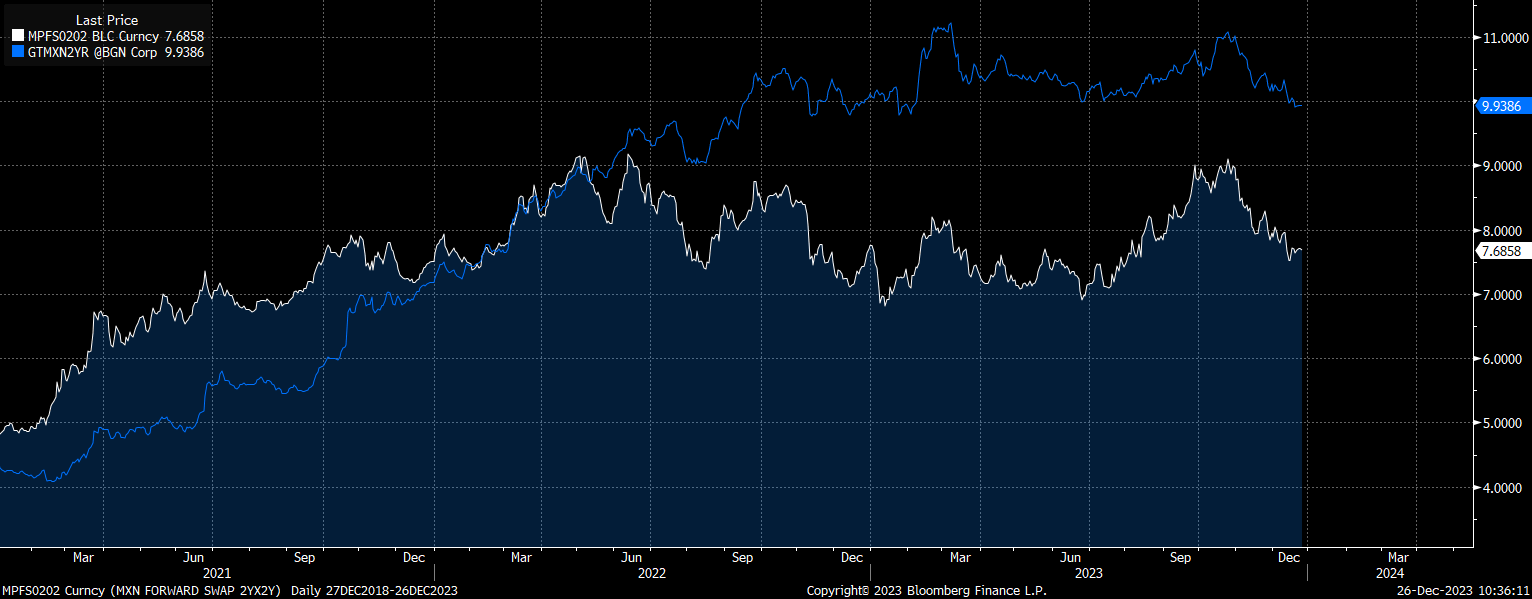
This tension with the Bank of Mexico should be monitored in direct connection with how the FED is making decisions for informed views on the Peso/USD exchange rate.
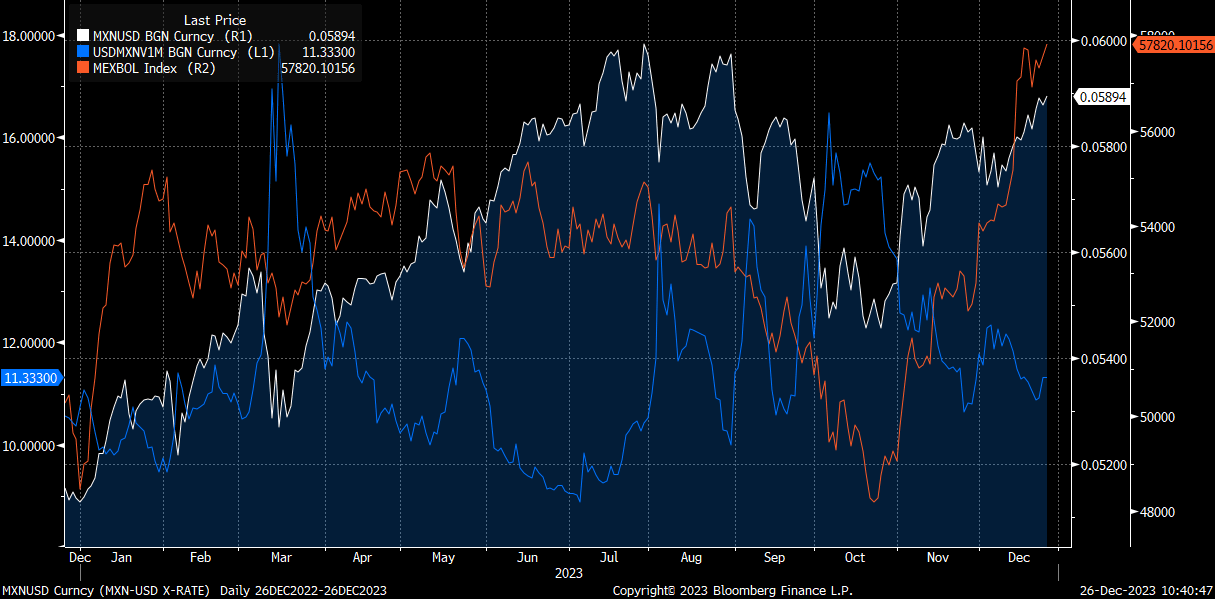
Implied volatility has been moving inversely to the Peso price action in its correlation with equities. Continue to watch for low implied volatility and risk on moves characterized by a strong Peso and rallying equities:
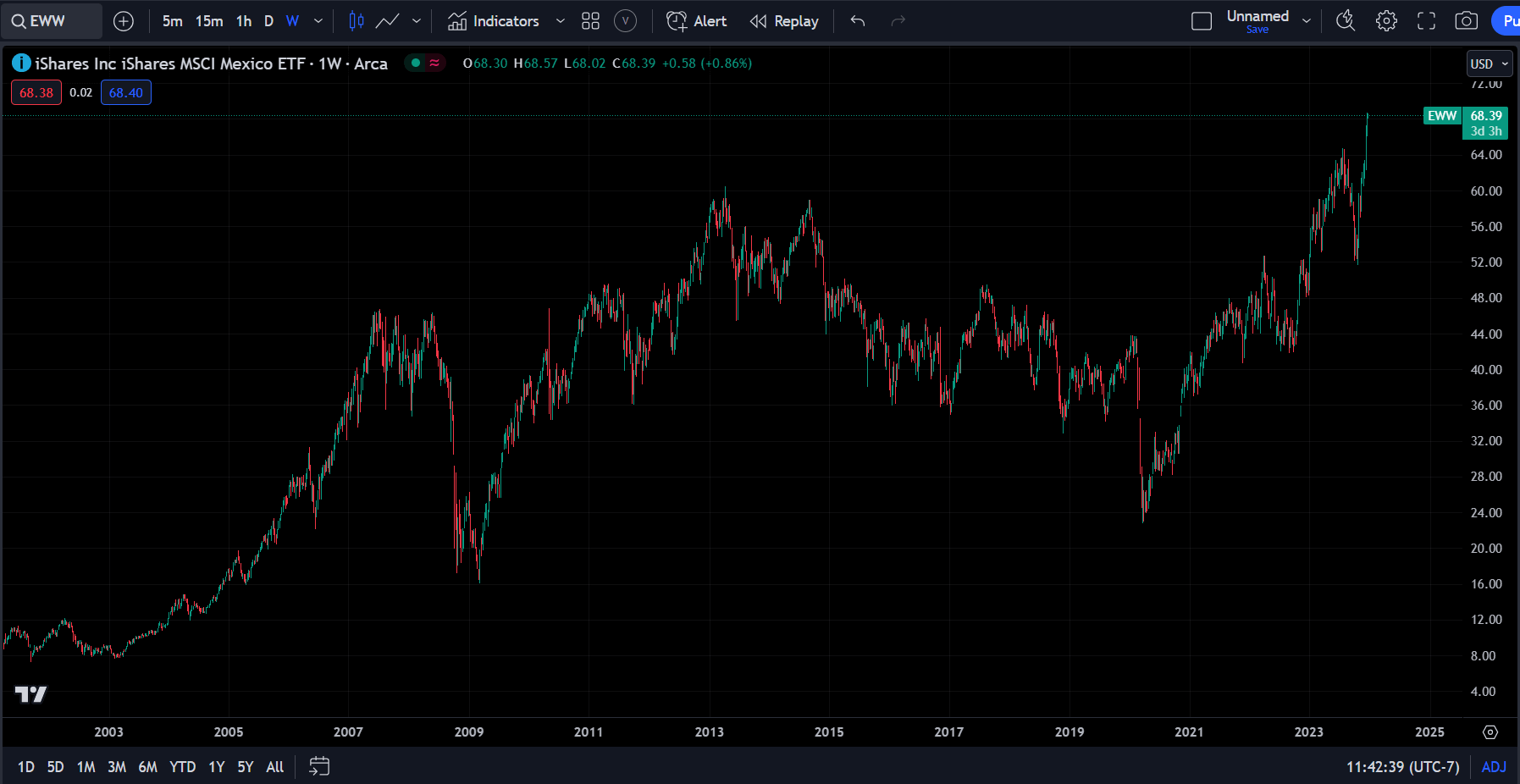
The EWW ETF offers great exposure to Mexico. As more and more investors recognize the necessity of being long specific emerging markets without having exposure to China, Mexico will likely become a greater focus in allocation ideas.
My views:
I think being long Mexican equities and the Peso offer great risk-reward on a 18-month time horizon.
Additional resources for research and trading in Mexican markets:
As we pull everything together, there are a lot of great resources out there on Mexico and its financial markets. The following books are great resources:
"Mexico: What Everyone Needs to Know" by Roderic Ai Camp - This book provides a comprehensive overview of Mexico's political, economic, and social history, offering valuable context for understanding its current financial landscape.
"The Economics of Contemporary Latin America" by Beatriz Armendáriz and Felipe Larraín B. - Although not exclusively about Mexico, this book gives a deep dive into Latin American economies, including Mexico. It covers various economic issues that are crucial for understanding the regional financial dynamics.
"The Power of the Oligarchy in Mexican Finance" by Juan Carlos Moreno-Brid and Martín Puchet Anyul - This book focuses on the financial sector of Mexico, particularly the role of oligarchies and their impact on the economy.
"Emerging Markets in an Upside Down World: Challenging Perceptions in Asset Allocation and Investment" by Jerome Booth - This book, while not solely about Mexico, provides insights into emerging markets, including Mexico, and is helpful for understanding investment strategies in such economies.
"Why Nations Fail: The Origins of Power, Prosperity, and Poverty" by Daron Acemoglu and James A. Robinson - This book, though broader in scope, offers valuable insights into the economic and political factors that shape nations like Mexico.
"The End of Poverty: Economic Possibilities for Our Time" by Jeffrey Sachs - Sachs' work includes case studies and discussions relevant to developing countries, including aspects of the Mexican economy.
Peter Zeihan has some great videos on Mexico:
What Role Do the Cartels Play in US - Mexico Trade? || Peter Zeihan
Why The US Needs Mexico: Replacing Chinese Manufacturing || Peter Zeihan
There are a lot of good SSRN papers on Mexico as well:
On Mexican Financial Markets
Capital Flows to Latin America: Is There Evidence of Contagion -
Inflation Expectations and Risk Premia in Emerging Bond Markets -
Does Investor Sentiment Predict Future Mexican Stock Market Returns? -
Financial Markets Diffusion Patterns - The case of Mexican -
System Dynamics: A Stock Index Model Applied to the Mexican Case -
Restructuring and Forgiveness in Financial Crises A: The Mexican Peso -
On the Economy from a Macroeconomic Perspective in Mexico
Macroeconomic Effects of High Interest Rate Policy: Mexico's -
Subnational Public Debt Sustainability in Mexico: Is the New -
Mexico from the 1960s to the 21st Century: From Fiscal Dominance -
Monetary Policy Uncertainty in Mexico: An Unsupervised Approach -
Poverty and Economic Growth in Mexico by Jorge Garza-Rodriguez -
Mexico: Illicit Financial Flows, Macroeconomic Imbalances, and the -
An Economic Perspective on Mexico's Nascent Deregulation of -
Poverty Convergence in a Time of Stagnation: A Municipal-Level -
On NAFTA USMCA Agreement Focusing on Mexico from a Trade Perspective
The USMCA and Mexico’s Prospects under the New North American Trade -
The U.S.-Mexico Trade Relationship under AMLO: Challenges and -
The USMCA and Investment: A New North American Approach? -
The USMCA: Updating NAFTA by Drawing on the Trans-Pacific -
From NAFTA to USMCA: Can a Good Idea that Came Too Late Be Born -
The Trade and Economic Impact of the USMCA: Making Sense of the -
United States–Mexico–Canada Agreement (Usmca): A Lot of -
From NAFTA to USMCA: Providing Context for a New Era of Regional -
The United States-Mexico-Canada Agreement: Developing Trade -
On Mexico's Political, Fiscal, and Monetary Systems
Mexico from the 1960s to the 21st Century: From Fiscal Dominance to... -
Mexico Needs a Fiscal Twist: Response to COVID-19 and Beyond -
Lessons from the Monetary and Fiscal History of Latin America -
Monetary Policy Uncertainty in Mexico: An Unsupervised Approach -
The Political Economy of Fiscal Reforms in Latin America: Mexico -
Subnational Public Debt Sustainability in Mexico: Is the New Fiscal... -
Mexico's Monetary Policy Communication and Money Markets -
Fiscal Policy and the Cycle in Latin America: The Role of... -
Conclusion:
If you are new to global macro, you can begin to see there is A TON that goes into building a proper allocation framework for an idea or country. If you are taking a long term view, then you are quantifying every moving part, analyzing all relevant literature and identifying all contingency scenarios.
You can also begin to see that there is only so much you can do in a single Substack article. We could easily spend the next 6 months going through every investment implication connected to USMCA and develop a comprehensive strategy for dynamically managing capital across the various risk premias in Mexico.
This is what I spend the majority of my time on. Why? Because I am creating a scarce commodity. How many people do you think are doing this level of analysis and connecting to trades that are dynamically managed? Very few. Most people are reading a few investment bank reports, throwing on some risk and hoping for the best.
Just remember, nothing exceptional takes a small amount of time.
In the information age, you simply need to be at the right place, at the right time, with the right information to succeed
Best part about this is that it takes a lot of what is in Peter Zeihan’s books (which are super interesting from a thought exercise perspective) and actually applying an investment framework overlay on top of it which is what actually matters. Until you make a directional bet on it it’s just an academic debate.